Electrical Panel Upgrade Code Requirements: What Actually Passes Inspection (And What Fails)
An electrical panel can energize every circuit in the house — and still fail inspection.
That’s the part most homeowners don’t realize.
Code compliance is not about “does it work?”
It’s about whether the installation satisfies the version of the National Electrical Code (NEC) adopted by your local Authority Having Jurisdiction (AHJ) — and whether the inspector can sign off without hesitation.
This guide explains the electrical panel upgrade requirements that actually determine pass vs fail.
If you’re looking for pricing first: panel upgrade cost
If you’re unsure whether your project is a replacement or capacity increase: panel upgrade vs replacement
The Two Rulebooks That Control Your Panel Upgrade
Every panel upgrade must satisfy:
 The NEC (NFPA 70)
The NEC sets national safety standards for electrical installations.
 Local Adoption + Amendments
Your state, county, or city may:
- Adopt a specific NEC edition
- Add amendments
- Enforce additional utility requirements
Two neighboring counties can enforce different code editions.
Never assume “it passed in another city” means it will pass in yours.
Core NEC Areas That Decide Panel Upgrade Compliance
When inspectors evaluate a panel upgrade, they’re typically enforcing requirements rooted in:
- NEC 110 – General installation requirements (including 110.3(B) listed equipment)
- NEC 230 – Services
- NEC 250 – Grounding and bonding
- NEC 408 – Panelboards
You don’t need to memorize the code book.
But you do need to understand how these sections translate into inspection decisions.
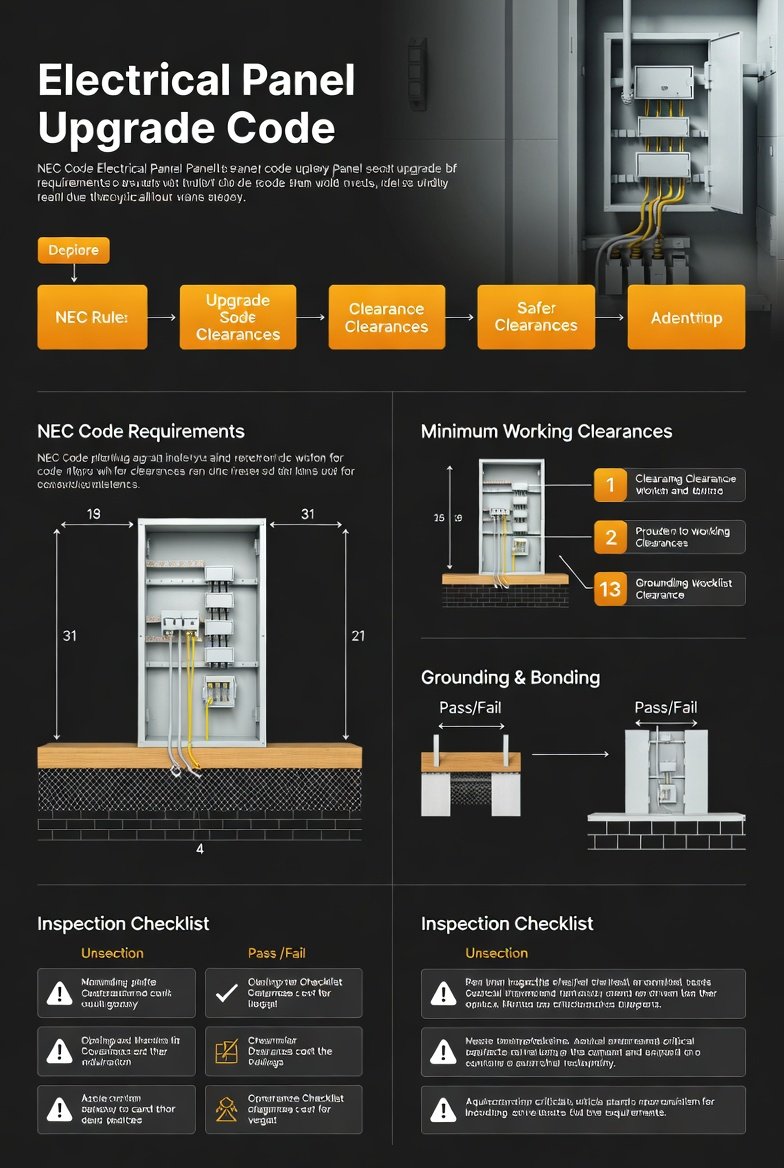
Working Space & Accessibility Requirements
If the panel cannot be safely serviced, it can fail.
Inspectors evaluate:
- Adequate working space in front of the panel
- Clear access (not blocked by permanent structures)
- Panel mounting height and serviceability
- Dedicated space considerations
Most failures here occur during relocations.
If you’re relocating the panel, confirm location suitability before installation.
Pass vs Fail — Clearance Example
Situation | Likely Result |
Panel accessible with proper service space |
|
Panel partially blocked by fixed shelving |
|
Panel behind permanent obstruction |
|
 Pass
PassClearance failures are easy to prevent — but often overlooked.
Service Equipment & Disconnect Requirements (NEC 230)
For service upgrades (100A → 200A), inspectors check:
- Proper service disconnect configuration
- Conductor suitability for upgraded rating
- Utility coordination compliance
- Meter/service equipment compatibility
If your load requires upgrading, verify it first: calculation for upgrade
Increasing panel size without properly sized service conductors is a guaranteed failure.
 Grounding & Bonding (NEC 250) — The #1 Failure Zone
Most panel upgrade inspection failures involve grounding and bonding.
Inspectors commonly flag:
- Improper neutral-ground bonding location
- Missing or incorrect grounding electrode conductor
- Improper bonding of enclosures
- Neutral/ground mixing in subpanel scenarios
Field reality:
Inspectors rarely fail panels for aesthetics — they fail them for bonding errors and improper conductor configuration.
If you’re upgrading due to warning signs like heat or breaker failure, review: an electrical panel upgrade
 Listed Equipment & Breaker Compatibility (NEC 110.3(B))
Code requires that listed equipment be installed according to its listing and labeling.
In practical terms:
- Breakers must be approved for that specific panel
- Mixing brands because they “fit” can trigger failure
- Backfed configurations must match manufacturer instructions
Breaker-panel mismatch is one of the most common red-tags in retrofit upgrades.
 Panelboard Requirements (NEC 408)
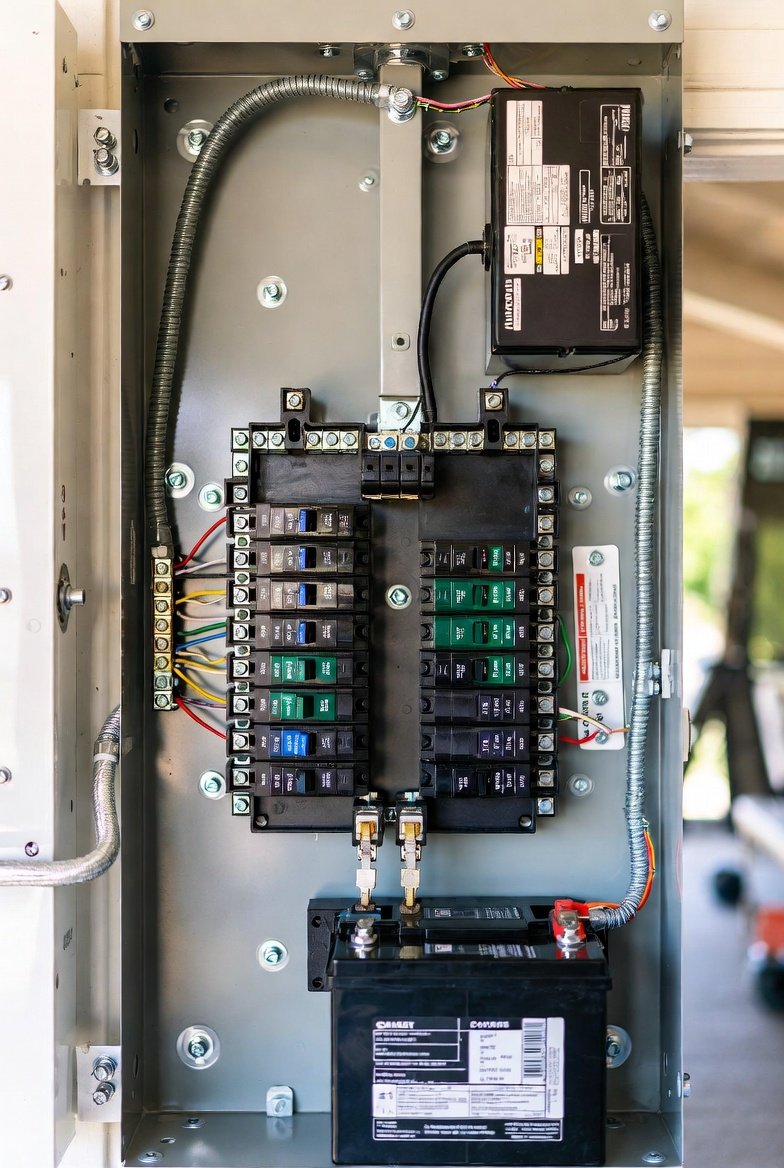
Inspectors evaluate:
- Proper conductor termination
- Torque compliance
- Circuit directory labeling
- Panel suitability for environment
Missing circuit labels alone can trigger a correction notice.
Labeling is simple.
Failing because of it is unnecessary.
What Inspectors Actually Red-Tag
High-frequency red-tag triggers include:
- Evidence of heat damage inside enclosure
- Double-tapped neutrals where not permitted
- Incorrect neutral-ground bonding in subpanels
- Breaker not listed for panel
- Working space violation
- Improper grounding electrode connection
- Incorrect service conductor sizing
If you want to see inspection specifics, review: panel inspection
Most Misunderstood Code Areas
 “If it works, it’s fine.”
No. Code compliance is about safety standards — not functionality.
“My electrician said it’s okay.”
Inspectors enforce adopted code — not contractor opinion.
“It passed in another city.”
Local amendments differ.
“The old panel didn’t require this.”
Upgrades must meet current enforced standards.
Electrical Panel Upgrade Requirements by State — What Actually Matters
States adopt different NEC editions.
Local jurisdictions may:
- Amend grounding rules
- Require additional disconnect provisions
- Modify service upgrade procedures
Always verify:
- Which NEC edition is enforced locally
- Whether amendments exist
- Utility service requirements
The safest question to ask your electrician:
“Which NEC edition is currently enforced here?”
If they hesitate, confirm with your AHJ.
Code Minimum vs Best Practice
Important distinction:
- Code compliance = minimum enforceable safety standard
- Best practice = future-proofing and long-term reliability
Code may allow a configuration that passes inspection — but upgrading grounding components or conductor routing beyond minimum may improve longevity and reduce future issues.
Pass vs Fail Quick Matrix
Scenario | Likely Outcome |
Proper bonding at service equipment |
|
Neutral bonded in subpanel |
|
Breakers listed for panel |
|
Mixed breaker brands not listed |
|
Correct conductor sizing |
|
Undersized service conductors |
|
Clear working space |
|
Panel behind obstruction |
|
Inspection logic is predictable when you understand these patterns.
How Code Compliance Connects to Permits
Permits and code enforcement are linked.
Without permit:
- No official inspection
- No AHJ approval
- Possible insurance and resale complications
If you need permit breakdowns: upgrade permit cost
Homeowner Code Compliance Checklist
Before installation begins, confirm:
- Permit is issued
- NEC edition enforced locally is identified
- Panel location meets clearance requirements
- Grounding and bonding plan is reviewed
- Breakers are listed for the panel
- Conductors match upgraded service rating
- Utility coordination is scheduled
Most inspection failures can be prevented before installation begins.
Final Verdict
Electrical panel upgrade code requirements are not abstract.
They revolve around:
- Clearance
- Service configuration
- Grounding & bonding
- Conductor sizing
- Listed equipment compliance
- Proper labeling
Panels don’t fail inspection because they don’t turn on.
They fail because they violate predictable code principles.
Understand those principles — and your upgrade passes smoothly.