
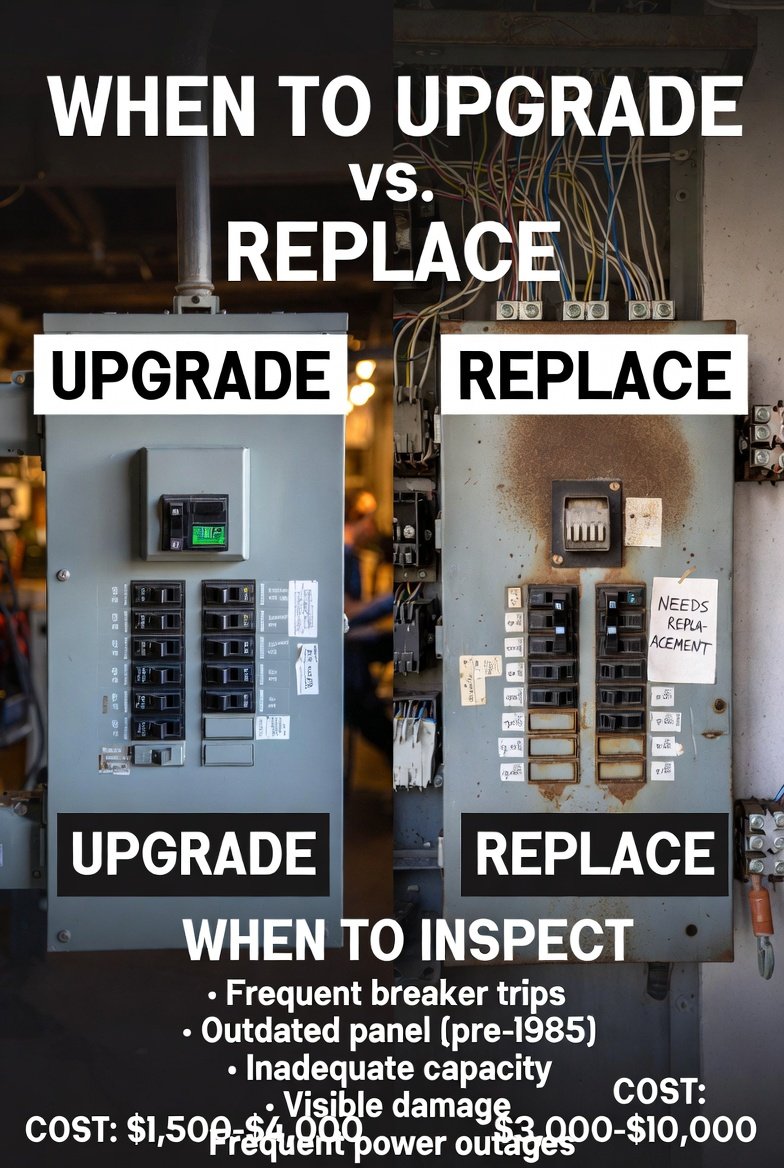
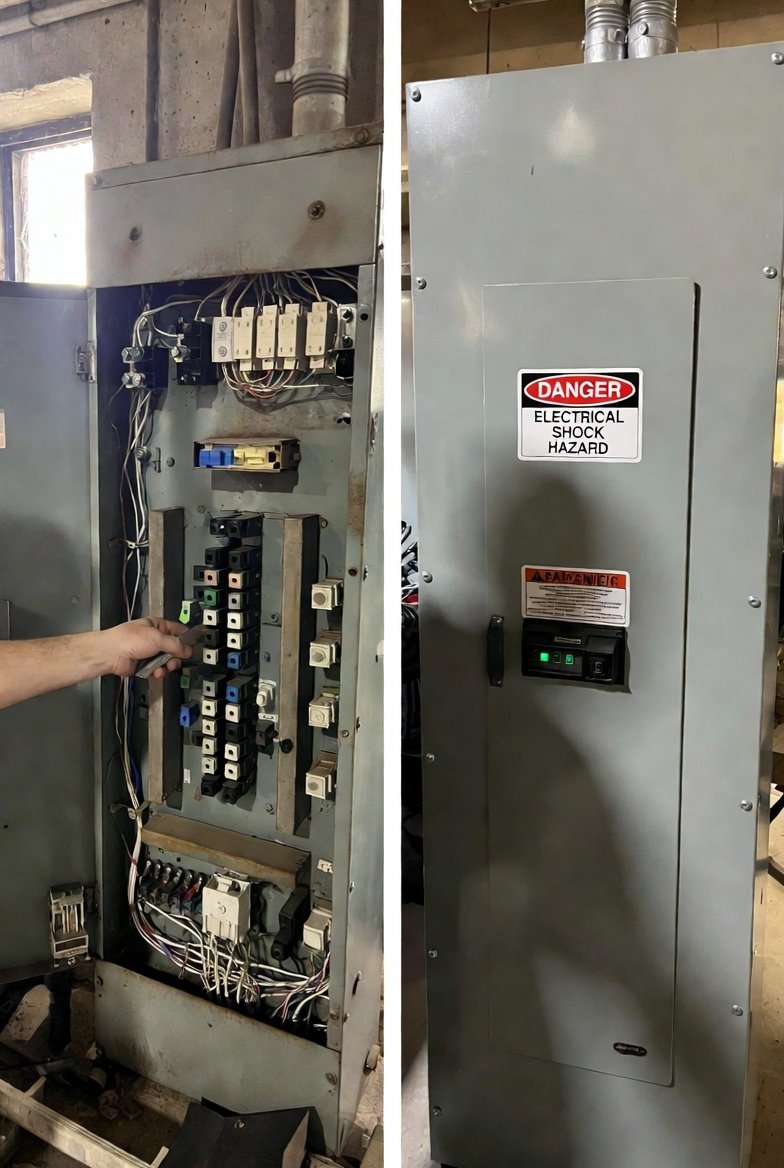
What Inspectors Actually Red-Tag (Real Failure Triggers)
This is where replacement becomes mandatory.
Inspectors commonly fail panels for:
- Burn marks on bus stabs (even if breakers still seat)
- Double-tapped neutrals
- Neutral-ground bond present in a subpanel
- Water staining inside the enclosure
- Breakers not listed for the panel model
- Panel models appearing on insurer or utility exclusion lists
- Corroded lugs or loose service conductors
When these are present, increasing amperage alone will not pass inspection.
Replacement becomes required.
Can You Upgrade Without Replacing and Still Pass Inspection?
Many homeowners quietly ask this question.
When It Can Pass
- Enclosure in good condition
- No heat damage
- No corrosion
- Proper bonding
- Panel rated for higher amperage
When It Will Not Pass
- Visible bus damage
- Improper bonding
- Known unsafe panel types
- Water intrusion
- Overfilled breaker spaces
Grey-Area Situations
- Minor corrosion
- Labeling inconsistencies
- Local inspector discretion
Permit requirements vary by jurisdiction.
Details here: panel upgrade permits
Decision Shortcut (Simple Rule)
If there is a safety issue, replacement comes first.
If there is no safety issue but capacity is insufficient, upgrade makes sense.
If both conditions exist, the project is combined.
Real-World Scenarios
1985 Home Adding an EV Charger
- Existing 100A panel
- Near capacity
- No visible damage
Correct path: Upgrade
Load calculation explained here: electrical panel upgrade
1990 Panel Showing Heat Damage
- Burn marks present
- Breakers loose
- Same amperage sufficient
Correct path: Replacement
Wrong choice penalty:
Upgrading a damaged panel often fails inspection and forces full rework.
1970 Home With 60A Service
- Entire supply undersized
Correct path: Service Upgrade
Wrong choice penalty:
Replacing only the panel leaves the home underpowered.
Unsafe Panel + Adding Heat Pump
Correct path: Replacement + Upgrade combined
Wrong choice penalty:
Replacing without upgrading may require a second project.
Panel Upgrade vs Service Upgrade
Feature | Panel Upgrade | Service Upgrade |
Increases Panel Capacity | Yes | Yes |
Replaces Meter Base | Sometimes | Yes |
Utility Work Required | Often | Always |
Increases Entire Home Supply | No | Yes |
Service upgrade modifies the entire incoming supply.
Panel upgrade modifies the panel capacity.
What Insurance Companies Actually Flag
Insurance carriers often request:
- Interior panel photos
- Confirmation of panel age (40+ years commonly flagged)
- Proof of permitted work
- Documentation that no excluded brands are installed
- Evidence of no heat damage
Replacement improves underwriting stability.
Upgrade improves modern load compatibility.
Non-permitted work is frequently denied.
Will Upgrading Fix Breaker Tripping?
Not always.
Breaker tripping may result from:
- Overloaded circuits
- Loose wiring
- Appliance faults
- Ground faults
If the panel is safe and capacity adequate, upgrading will not solve circuit-level issues.
Can a New Panel Increase Home Value?
Indirectly, yes.
Buyers and inspectors prefer:
- 200A service
- Clean labeling
- No visible safety concerns
Upgrade improves future load flexibility.
Replacement removes inspection red flags.
Pros & Cons Snapshot
Upgrade
Pros
- Supports EVs, heat pumps
- Adds breaker space
- Future-proofs home
Cons
- Higher cost
- Utility coordination
Wrong choice penalty:
Upgrading when replacement is required often fails inspection.
Replacement
Pros
- Corrects safety hazards
- Often lower cost
- Stabilizes insurance
Cons
- Does not increase capacity
Wrong choice penalty:
Replacing without upgrading may require another project later.
Final Perspective
Upgrade adds power.
Replacement restores safety.
Service upgrade increases total supply.
Inspectors prioritize safety first.
Capacity comes second.
The right choice depends on the condition of the panel and the load demands of the home — not just price.
Frequently Asked Questions
Should I upgrade or replace my electrical panel?
If unsafe, replace. If safe but undersized, upgrade. Some homes require both.
Is replacement cheaper than upgrade?
Yes, when amperage stays the same. Upgrades cost more because they increase capacity and may require utility coordination.
What is the difference between panel upgrade and service upgrade?
Panel upgrade increases panel capacity. Service upgrade increases total electrical supply from the utility.
Will upgrading fix breaker tripping?
Not necessarily. Tripping may be caused by wiring or circuit issues rather than insufficient panel capacity.
Can a new panel increase home value?
It can improve buyer confidence and inspection outcomes, especially when increasing from 100A to 200A service.