
Electrical Panel Upgrade vs Replacement: What’s the Difference?
Choosing between an electrical panel upgrade vs replacement starts with identifying what problem the home actually has. The two projects can involve some of the same equipment, but they do not necessarily solve the same problem.
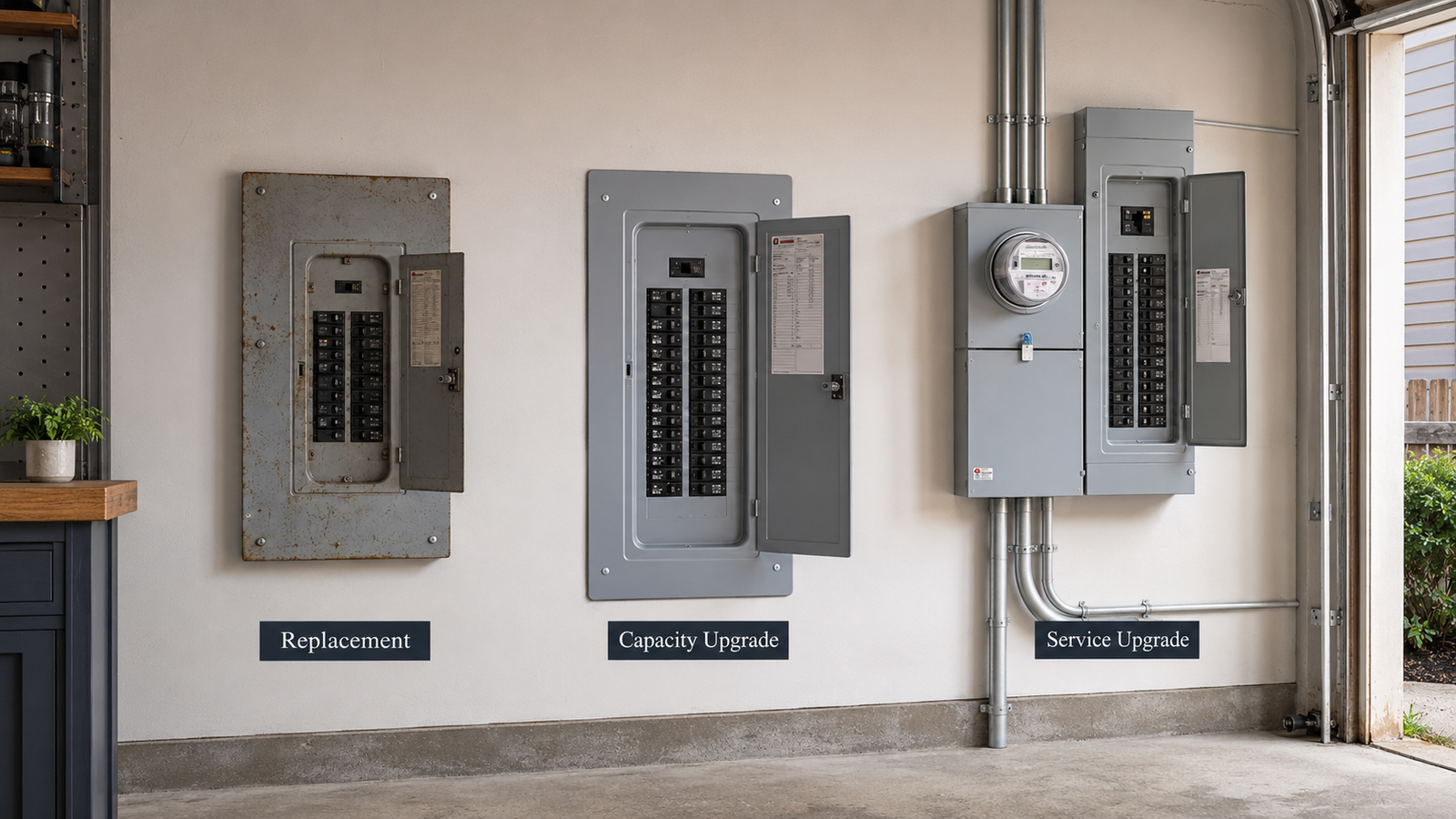
A panel replacement changes the existing panel or load-center equipment. The home’s electrical service capacity may stay the same.
A capacity upgrade is considered when the electrical system cannot adequately support the home’s present or planned loads. Increasing capacity may require changes beyond the panel itself.
A service upgrade extends into the incoming electrical service and may involve meter equipment, service conductors, disconnect equipment, or the utility connection.
Because electricians, contractors, and utilities do not always use these terms in exactly the same way, focus on the actual scope of work rather than the label on the estimate.
The decision usually comes down to three questions:
- Condition: Can the existing panel equipment remain in service?
- Capacity: Can the electrical system support the home’s current and planned loads?
- Service: If more capacity is required, does the incoming electrical service also have to change?
Sometimes none of those major projects is necessary. The existing service may be adequate and the issue may instead involve breaker space, a branch circuit, or another targeted correction.
| Project | Main Question | Must Capacity Increase? | Typical Scope |
|---|---|---|---|
| Panel replacement | Does the existing panel equipment need to be changed? | No | Panel or load center, breakers, connections, and corrections associated with the replacement |
| Capacity upgrade | Does the home need more electrical capacity? | Yes, when the load assessment shows it is necessary | Panel and potentially other service equipment |
| Service upgrade | Must the incoming electrical service change to provide the required capacity or configuration? | Usually | Service conductors, meter or service equipment, disconnects, utility coordination, and often the panel |
| Neither major project | Can the planned work be completed without replacing the panel or increasing service capacity? | No | A new circuit, breaker-space solution, subpanel where appropriate, load management, or another targeted correction |
These scopes can overlap.
A homeowner might replace damaged panel equipment while keeping the same service capacity. Another home may have serviceable equipment but need more capacity for new electrical loads. A third project may require changes to both the panel and the incoming service.
That is why two contractors can use the word upgrade while proposing substantially different projects.
Step 1: Check the Condition of the Existing Panel
Start with the equipment itself.
The important question is not simply how old the panel is. It is whether its condition, configuration, and available compatible components allow it to remain serviceable.
Conditions that can justify further evaluation include:
- significant corrosion or water-related deterioration
- confirmed overheating or heat damage
- physical damage to the enclosure or internal components
- damaged bus bars or other critical internal equipment
- compatible replacement components that are no longer reasonably available
- a documented product defect or recall relevant to the installed equipment
- installation problems that cannot reasonably be corrected while keeping the existing panel
Finding a problem does not automatically mean the complete panel must be replaced.
Some defects may be limited to individual components, connections, or installation details. Other conditions can make complete replacement the more practical corrective scope.
A condition problem tells you whether existing equipment can remain in service. It does not, by itself, tell you that the home needs more electrical capacity.
If the existing capacity is adequate but the panel itself needs to be changed, the project may remain a same-capacity replacement.
For pricing and scope, see our guide to electrical panel replacement cost.
Step 2: Determine Whether the Home Actually Needs More Capacity
If the existing equipment can remain in service—or if replacement is being evaluated separately—the next question is whether the electrical system can support the home’s current and planned loads.
This becomes especially important when adding equipment such as:
- an EV charger
- a heat pump
- a heat-pump water heater
- an electric range or cooktop
- an electric dryer
- a major addition or remodel
- several new high-demand loads
The answer should come from an appropriate electrical-load assessment rather than from the age of the house, the appearance of the panel, or a single breaker that keeps tripping.
A home with 100-amp service does not automatically need 200 amps simply because one new electrical appliance is being added.
Likewise, a 200-amp main breaker does not automatically prove that every proposed new load can be added without further evaluation.
The purpose of a load calculation is to determine whether the existing electrical system has sufficient capacity for the proposed demand.
Our electrical panel load calculation guide explains that process in more detail.
A Full Electrical Panel Does Not Automatically Mean the Service Is Too Small
Breaker space and electrical capacity are not the same thing.
Breaker space describes whether the panel has suitable physical positions available for additional circuits.
Electrical capacity concerns whether the electrical system can support the calculated load.
A panel can run out of usable breaker spaces while the home’s service still has adequate capacity.
The opposite can also happen: a panel may have unused breaker positions while available electrical capacity is constrained by the loads already connected to the home.
Depending on the installed equipment and proposed work, a breaker-space problem may have solutions that do not require increasing service amperage, such as:
- an appropriate circuit-layout change
- listed breaker configurations permitted for that equipment
- a properly designed subpanel
- another distribution solution that preserves the existing service capacity
ENERGY STAR also recommends evaluating existing panel capacity and available options before assuming that every new electric load requires a larger panel or service. Its guidance discusses optimizing existing panel space and, in some situations, using load-management approaches to avoid unnecessary capacity increases. See ENERGY STAR’s electric-ready guidance.
A full panel is therefore a reason to evaluate the system—not proof that the home needs a 200-amp service upgrade.
Step 3: Determine Whether the Incoming Electrical Service Must Change
If the load assessment shows that additional capacity is genuinely required, the project may extend beyond the panel.
Possible service-related work can include:
- larger or different service conductors
- meter or meter-socket equipment
- service disconnect equipment
- overhead service components such as a mast or weatherhead
- underground service modifications
- utility coordination or approval
This is where a proposed panel upgrade can become a broader electrical-service project.
Utility involvement alone, however, does not prove that the home’s service capacity is increasing.
A utility may still need to disconnect and reconnect power for a same-capacity panel replacement. What matters is which equipment is changing and whether the available service capacity is actually being increased.
If the project involves increasing a home from approximately 100 amps to 200 amps, our 200 amp panel upgrade cost guide explains the broader scope that can accompany that change.
For broader capacity-upgrade pricing and major project cost drivers, see our electrical panel upgrade cost guide.
Sometimes You Need Neither a Panel Replacement Nor a Service Upgrade
Adding an EV charger, heat pump, electric water heater, or another significant electrical load does not automatically mean the main panel must be replaced or the service increased.
Depending on the existing system and calculated demand, the evaluation could show:
- enough existing capacity to add the new circuit
- adequate service capacity but insufficient breaker space
- a distribution change or subpanel is appropriate
- load-management equipment can control competing high-demand loads
- the problem requires a targeted correction rather than a capacity increase
- a genuine panel or service-capacity upgrade is necessary
Before approving a major electrical project, ask one question:
What constraint are we actually trying to solve?
Is it equipment condition, breaker space, calculated electrical capacity, or the incoming service itself?
Once that is clear, the electrical panel upgrade vs replacement decision becomes much easier to understand—and the contractor’s proposed scope becomes much easier to evaluate.
What Inspection Findings Actually Mean
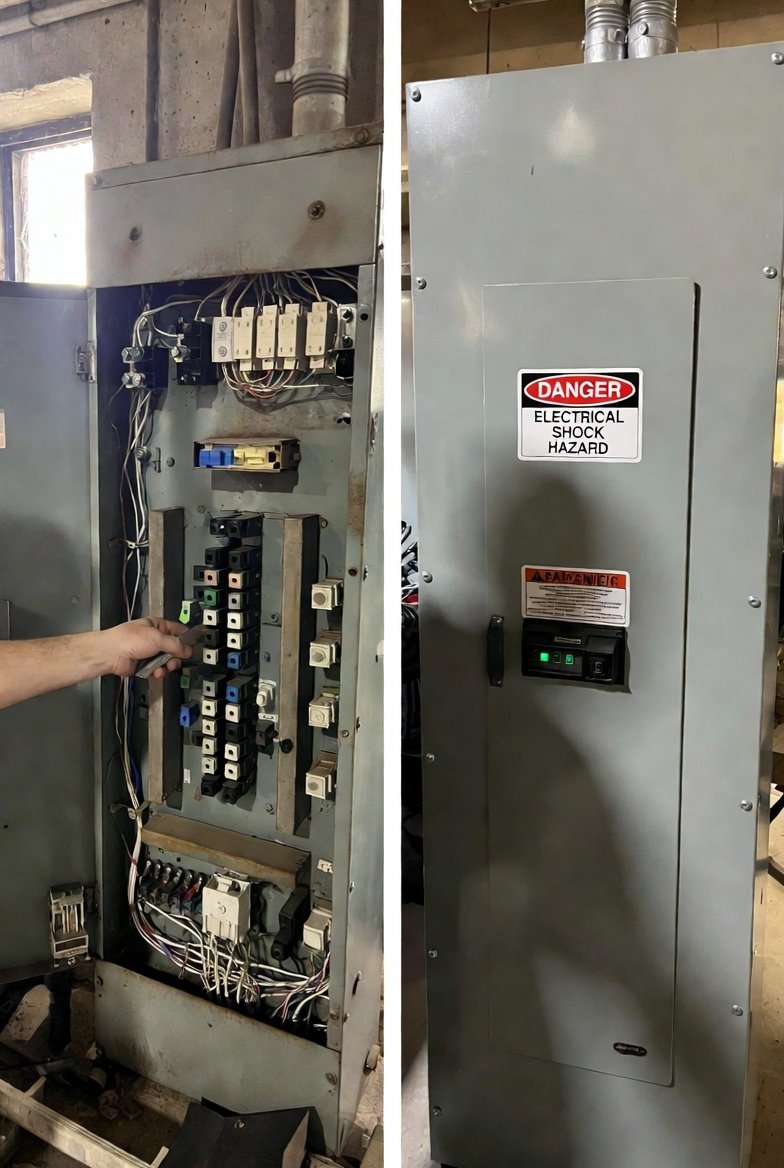
An inspection finding identifies a condition that needs attention. It does not automatically determine the entire project scope.
An electrician or inspector may identify problems such as:
- improper terminations
- unsuitable or incompatible breakers
- grounding or bonding deficiencies
- evidence of overheating
- corrosion or moisture-related deterioration
- damaged internal components
- incorrect or incomplete circuit identification
- other installation defects
Some findings may be corrected without replacing the complete panel. Others can make replacement the more appropriate corrective scope.
The useful question is not simply “Did the panel fail inspection?” It is:
What condition was identified, and what work is required to correct it?
A localized defect does not automatically prove that the home needs a new panel, additional amperage, or a full service upgrade.
For more detail on the inspection process, see our electrical panel upgrade inspection guide.
Repair or Replace the Existing Panel?
When existing electrical capacity is adequate, the real decision may be repair versus same-capacity replacement rather than a capacity increase.
A targeted repair may be possible when the problem is confined to a component, connection, breaker, or correctable installation issue and the remaining equipment is suitable to stay in service.
Replacement becomes more likely when the condition affects the panel more broadly, such as:
- substantial enclosure damage
- damaged bus bars or other critical internal components
- extensive corrosion
- significant heat damage
- compatible replacement components that are no longer reasonably available
- a documented equipment problem for which replacement is the appropriate remedy
- defects that cannot reasonably be corrected while retaining the existing equipment
Age alone does not determine the answer.
An older panel that remains serviceable is different from equipment with confirmed physical damage or components that can no longer be appropriately maintained.
If complete replacement is recommended, ask the contractor to identify what condition makes replacement preferable to a targeted correction.
When Load Management Can Change the Upgrade Decision
More electrical load does not always require more service amperage.
In some installations, load-management equipment can control when high-demand loads operate so that competing loads do not exceed the available capacity at the same time.
This may be useful when adding equipment such as an EV charger or another large electric load.
Load management is not a universal substitute for a service upgrade. Whether it is appropriate depends on the existing service, calculated load, connected equipment, control method, manufacturer requirements, and applicable local requirements.
The important point is that increased amperage should be justified by the electrical demand and project requirements rather than assumed to be the only solution.
Four Common Electrical Panel Decisions
Damaged Panel, Adequate Capacity
The panel has confirmed physical or internal damage, but the home’s existing electrical capacity is adequate for present and planned loads.
Likely direction: evaluate repair or same-capacity panel replacement.
There may be no reason to increase service amperage simply because the panel itself requires corrective work.
Serviceable Panel, New Electrical Loads
The existing equipment is serviceable, but the homeowner plans to add an EV charger, heat pump, or another significant electrical load.
Likely direction: evaluate the load before choosing a larger service.
The result may support the existing system, a load-management strategy, or additional capacity. The planned appliance alone does not determine the answer.
Insufficient Capacity With Broader Service Changes
The electrical-load assessment shows that greater capacity is required, and providing it requires changes beyond the panel.
Likely direction: broader service-upgrade scope.
The project may involve service conductors, meter equipment, disconnect equipment, utility coordination, and panel work.
Panel Problem and Insufficient Capacity
The existing panel requires replacement and the electrical system also lacks the capacity needed for planned loads.
Likely direction: evaluate a combined replacement and capacity project.
Addressing both needs as one properly scoped project can avoid replacing equipment only to modify or replace it again during a later capacity increase.
Will a Panel Upgrade Fix Breaker Tripping?
Not necessarily.
A repeatedly tripping breaker can result from several different conditions, including:
- an overloaded branch circuit
- a short circuit
- a ground fault
- an appliance fault
- a wiring problem
- a loose or deteriorated connection
- another circuit-specific condition
Increasing the home’s service capacity does not automatically correct those problems.
If the panel and service have adequate capacity, increasing amperage may do nothing to solve a fault occurring on an individual branch circuit.
Breaker tripping should therefore be diagnosed before it is used as justification for a major panel or service project.
Our circuit breaker issues guide covers those problems separately.
Permits and Utility Coordination Do Not Define the Project
Panel replacement and capacity-increase projects can both involve electrical permits, inspections, and utility coordination.
Those requirements do not by themselves tell you whether the work is a replacement, capacity upgrade, or broader service upgrade. The distinction comes from what equipment and electrical capacity are actually changing.
Before work begins, the proposal should make clear:
- who obtains the electrical permit
- who schedules required inspections
- whether utility coordination is required
- who arranges any necessary disconnect and reconnect
- whether the service rating is changing
- whether meter or other service equipment is included
Our electrical panel upgrade permit guide explains the permitting side in more detail.
How to Compare Two Different Contractor Recommendations
If one electrician recommends replacement and another recommends an upgrade, do not start by comparing the final prices.
First determine what problem each contractor says the proposed work will solve.
1. What Is Wrong With the Existing Panel?
If replacement is recommended, ask for the specific condition behind that recommendation.
Is there physical damage, heat damage, corrosion, unavailable compatible equipment, or another defect that makes replacement appropriate?
2. Why Does the Service Capacity Need to Increase?
If additional capacity is recommended, ask what electrical-load assessment supports it.
The recommendation should be tied to existing and proposed loads rather than based only on the home’s age or current amperage.
3. What Equipment Is Actually Changing?
Ask whether the proposal includes:
- panel equipment
- breakers
- service conductors
- meter equipment
- service disconnect equipment
- grounding or bonding work
- utility-related work
Two proposals described as “panel upgrades” can include substantially different work.
4. Does the Project Increase the Service Rating?
This question separates many same-capacity panel projects from broader capacity work.
Installing a new panel does not automatically mean that the home’s electrical service rating is increasing.
5. Could a More Targeted Solution Address the Problem?
Depending on the condition and electrical load, ask whether the appropriate solution could instead involve:
- a targeted repair
- a same-capacity panel replacement
- a breaker-space solution
- a subpanel
- load management
- another focused correction
The goal is not to choose the smallest project regardless of circumstances. It is to make sure the proposed scope matches the actual electrical problem.
Frequently Asked Questions
Can I Replace an Electrical Panel Without Increasing Amperage?
Yes. A panel can be replaced while maintaining the existing service capacity when additional amperage is not required and the surrounding electrical system can remain appropriately configured.
That is a same-capacity replacement rather than a service-capacity increase.
Is Panel Replacement Always Cheaper Than an Upgrade?
No. Cost depends on the actual scope rather than the terminology used for the project.
A straightforward same-capacity replacement may cost less than a project requiring increased service capacity, while a more complicated replacement involving relocation, damaged conductors, or other corrective work may cost more.
For detailed pricing, compare our electrical panel replacement cost and electrical panel upgrade cost guides.
Does a 200-Amp Panel Mean the Home Has 200-Amp Service?
Not necessarily.
The rating of the panel enclosure alone does not establish the rating of the complete electrical service.
Service capacity depends on the configuration and ratings of the service equipment and conductors supplying the home. If capacity matters to a proposed project, it should be verified rather than inferred from one equipment label.
Bottom Line
The right electrical panel upgrade vs replacement decision starts with identifying the actual problem rather than choosing a project based on terminology alone.
If the issue is the condition of the panel, determine whether a targeted correction or replacement is appropriate.
If the issue is electrical capacity, determine what the home’s existing and planned loads actually require.
If providing that capacity requires changes to the incoming service, the work may expand into a broader service upgrade.
And sometimes a more targeted solution can address the problem without either a complete panel replacement or an increase in service amperage.
Before approving the work, make sure the recommendation answers three questions clearly:
What problem exists? What equipment must change? Why does that scope solve the problem?