
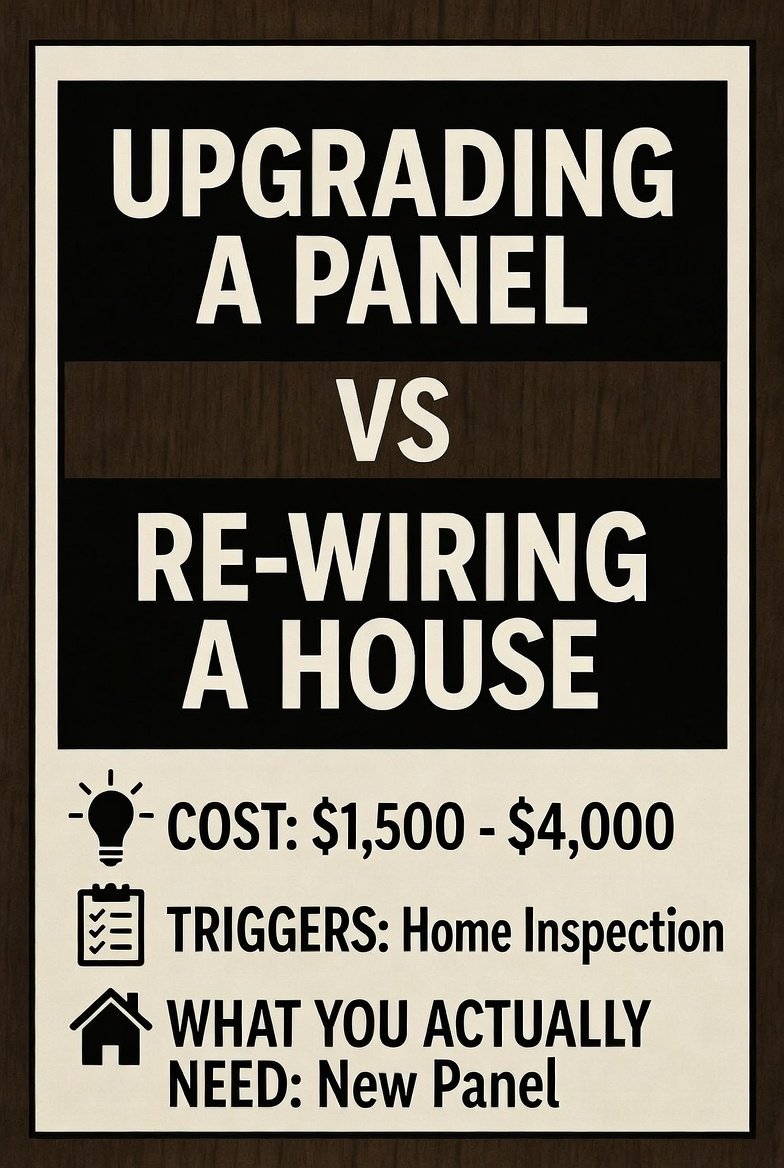
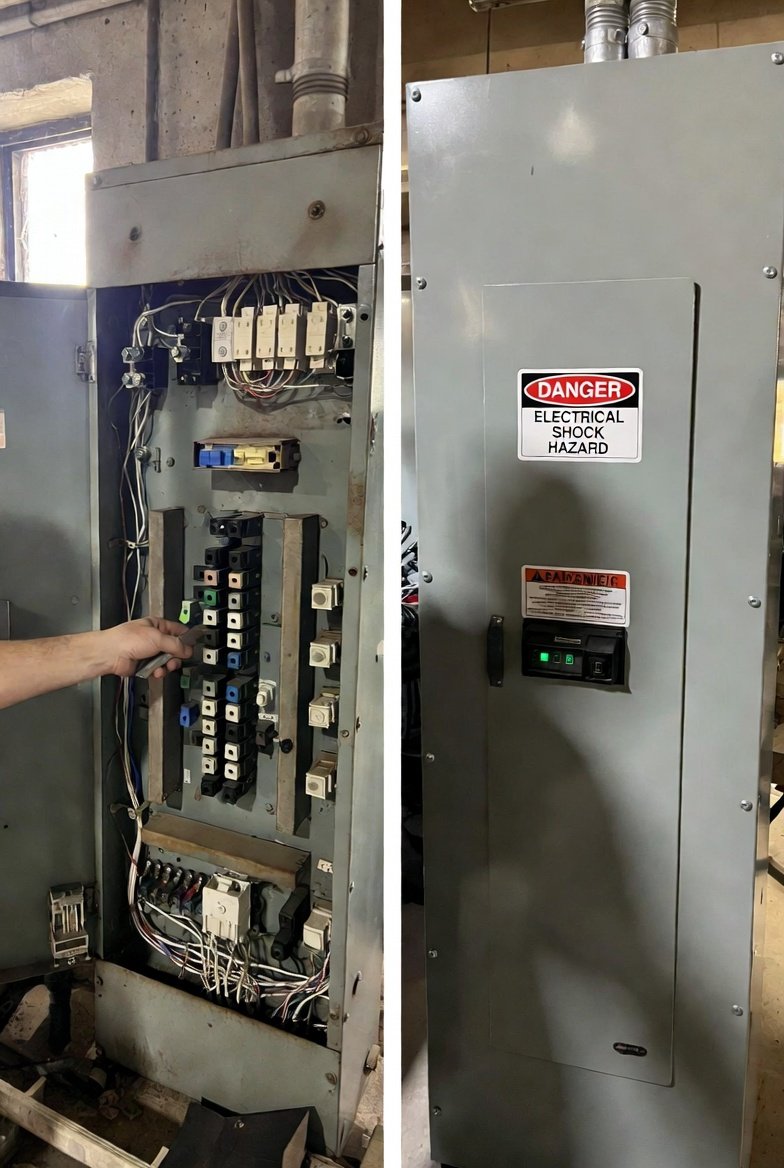
What Panel Upgrades Actually Fix
Panel upgrades solve:
- Insufficient amperage
- No breaker space
- EV charger installation
- Heat pump additions
- Solar interconnection limits
They do not fix:
- Brittle insulation
- Hidden overheating
- Ungrounded circuits
- Aluminum branch wiring hazards
What Rewiring Actually Fixes
Rewiring solves:
- Aging conductors
- Damaged insulation
- Arc fault risk
- Ungrounded circuits
- Hidden safety concerns
It does not:
- Increase service amperage
- Add breaker capacity
- Solve total load shortages
If breaker trips are caused by undersized service, rewiring won’t fix that.
What Inspectors Actually Red-Tag
Rewiring becomes mandatory when inspectors find:
- Melted insulation
- Arcing evidence
- Burn marks
- Improper splices
- Exposed conductors
- Neutral-ground bonding errors
Panel upgrades become mandatory when:
- Service amperage insufficient
- No breaker space
- Unsafe or obsolete panel enclosure
Permit details explained here: upgrade permits
Can You Upgrade Without Rewiring and Still Pass?
Usually Passes When:
- Wiring is modern and grounded
- No visible insulation damage
- Circuits sized appropriately
- No overheating evidence
Usually Fails When:
- Knob-and-tube present
- Aluminum wiring improperly terminated
- Repeated arc faults
- Water damage inside walls
Grey areas depend on local inspection policy.
Staged Strategy (Often the Smartest Approach)
Many homes benefit from phased planning:
Step 1: Upgrade to 200 amps
Step 2: Rewire circuits gradually during remodel phases
This works when wiring is safe but aging.
Load calculation explained here: electrical panel upgrade
Wrong Choice Penalties
Choosing Upgrade When Rewire Is Required
- Inspection failure
- Insurance underwriting issues
- Forced rework
- Higher long-term cost
Choosing Rewire When Upgrade Was Needed
- Massive unnecessary expense
- Continued capacity limitations
- Second upgrade project later
What Happens If You Delay the Wrong Project?
Delaying necessary rewiring may result in:
- Insurance denial
- Escalating damage
- Emergency repair pricing
Delaying a required upgrade may result in:
- Repeated breaker trips
- Appliance limitations
- Failed renovation plans
Correct sequencing matters more than price alone.
Real-World Scenarios
1980 Home Adding EV Charger
Safe wiring. Limited capacity.
→ Upgrade
1955 Home With Knob-and-Tube
Ungrounded circuits. Brittle insulation.
→ Rewire (panel may follow)
1990 Home With Tripping Breakers
Modern wiring. Undersized service.
→ Upgrade
Upgrade vs replacement explained here: upgrade vs replacement
Mixed Condition Home
Some legacy circuits. Some modern. Capacity borderline.
→ Panel upgrade + targeted rewiring
Insurance & Resale Considerations
Insurance carriers often request:
- Interior panel photos
- Wiring type verification
- Proof of permitted upgrades
- Confirmation of no obsolete systems
Rewiring improves underwriting stability in older homes.
Upgrading improves resale appeal when modern loads are supported.
Pros & Cons Snapshot
Panel Upgrade
Pros
- Lower cost
- Less invasive
- Faster completion
- Supports modern appliances
Cons
- Doesn’t fix unsafe wiring
Wrong choice penalty: upgrading a hazardous system fails inspection.
Whole-House Rewire
Pros
- Eliminates hidden hazards
- Long-term safety
- Improves reliability
Cons
- Expensive
- Disruptive
- Time-consuming
Wrong choice penalty: rewiring without upgrading leaves capacity limited.
Final Decision Framework
Ask:
- Is there a safety issue behind the walls?
- Is there a capacity issue at the panel?
If safety issue → Rewire.
If capacity issue → Upgrade.
If both → Combined project.
Inspectors prioritize safety first.
Electricians evaluate load second.
Diagnosis should drive the decision — not price alone.
Frequently Asked Questions
Do I need to rewire when upgrading to 200 amps?
Not necessarily. If wiring is safe and grounded, upgrading alone may pass inspection.
How long does whole-house rewiring take?
Typically several days to weeks depending on access, home size, and wall repair requirements.
Can I stay in the house during rewiring?
Often yes, but expect partial power shutdowns and disruption.
Does rewiring require opening every wall?
Not always. Electricians can fish wires through cavities when possible.
Is rewiring worth it for resale?
In older homes with outdated wiring, yes — it improves insurability and buyer confidence.