
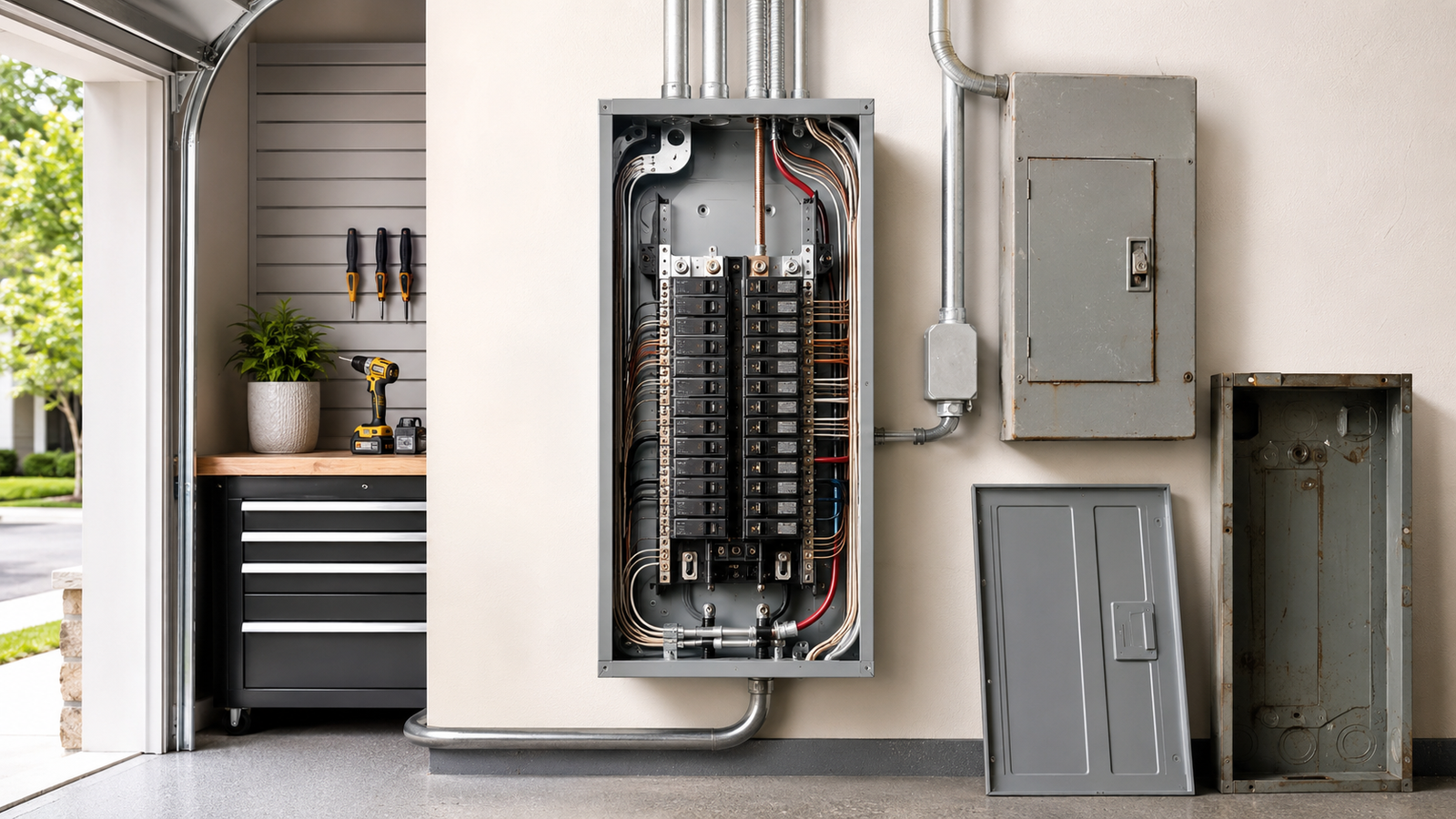
Electrical panel replacement costs vary widely because “replacing an electrical panel” can describe very different projects. A straightforward job may keep the existing service capacity and panel location, while a more involved replacement can include new breakers, grounding or bonding corrections, meter work, utility coordination, or changes to nearby service equipment.
Published national estimates reflect that variation. Angi’s 2026 replacement data places many projects between $518 and $2,191, while noting that more complicated replacements can reach roughly $4,500. Those figures are useful planning references, not guaranteed prices for a particular home.
Electrical Panel Replacement Cost at a Glance
The best way to understand a replacement estimate is to identify exactly what is being replaced or modified.
| Project Scope | What the Work Generally Involves | Cost Impact |
|---|---|---|
| Same-capacity panel replacement | Existing panel replaced in the same location without increasing service capacity | Usually the simplest replacement scope |
| Replacement with breaker or circuit corrections | New panel plus compatible breakers or corrections discovered during the work | Additional labor and materials |
| Replacement with grounding, bonding, or conductor work | Panel replacement plus related electrical corrections within the project scope | Can increase labor and material costs |
| Replacement involving meter or service equipment | Work extends beyond the load center into other service equipment | Higher-cost project with possible utility involvement |
| Panel relocation | Conductors, raceways, finishes, or service equipment may need to be moved | Often materially more expensive |
| Replacement with increased service capacity | New panel installed as part of a larger amperage increase | Becomes a broader electrical-service upgrade |
That last distinction is important.
Replacing an electrical panel does not automatically increase the home’s service capacity. Replacing a damaged or obsolete 100-amp panel with another correctly sized 100-amp panel is a different project from increasing a home from 100-amp to 200-amp service.
For the broader economics of increasing electrical capacity, see our electrical panel upgrade cost guide. If the project specifically involves moving from approximately 100 amps to 200 amps, see our 200 amp panel upgrade cost guide.
Why Electrical Panel Replacement Estimates Vary
Online cost estimates can appear contradictory because different contractors and cost datasets may include different amounts of work under the term panel replacement.
One estimate may cover the new panel, breakers, labor, permit, and inspection. Another may also include grounding corrections, damaged conductors, meter equipment, utility coordination, or repairs around the panel location.
Those are not necessarily two prices for the same project.
Before comparing the final numbers, check whether each quote addresses:
- the replacement panel or load center
- the main breaker, when applicable
- branch-circuit breakers included in the project
- removal and disposal of the old equipment
- permit and inspection responsibility
- grounding or bonding work included in the contract
- utility disconnect and reconnect, when required
- meter or other service-equipment changes
- corrections to damaged or unsuitable conductors
- wall, siding, or finish repairs
- work specifically excluded from the quoted price
A higher estimate may simply include work that another contractor has excluded or listed separately.
Does Amperage Affect Panel Replacement Cost?
Yes, but amperage alone does not determine the final price.
Larger equipment may cost more, but the bigger financial difference is often whether the home’s existing service equipment can remain in place.
For example, a home that already has adequate 200-amp service may need only a condition-driven 200-amp panel replacement. A different home receiving a new 200-amp panel may also need service conductors, meter equipment, utility work, or other changes to support increased capacity.
Both projects may casually be described as a “200 amp panel replacement,” even though their scope and cost are very different.
That is why the amperage printed on the main breaker is only one part of a replacement estimate.
What Does an Electrical Panel Replacement Quote Include?
A replacement estimate normally combines equipment, labor, permit-related work, and any project-specific corrections rather than one large hardware charge.
Panel and Breakers
The load center itself is only one part of the equipment package.
The required breakers depend on the circuits being served, the selected equipment, the work being performed, and locally adopted electrical requirements. A useful quote should identify what is included rather than relying on a vague line such as “new electrical panel.”
Requirements involving AFCI, GFCI, or other protective devices can depend on project scope and the electrical code adopted by the local authority having jurisdiction. They should be verified for the actual installation rather than assumed to apply identically to every replacement.
Electrical Labor
Labor can involve considerably more than removing one enclosure and mounting another.
Depending on the installation, the electrician may need to:
- identify and organize existing circuits
- transfer conductors to the replacement equipment
- correct damaged or unsuitable terminations within the project scope
- address applicable grounding or bonding conditions
- install compatible breakers
- coordinate the electrical shutdown
- label the completed panel
- prepare the work for inspection
Older or previously modified wiring can make a replacement more complicated, but the age of the house alone does not determine the amount of corrective work required. The actual condition and configuration of the electrical system matter more.
Permit and Inspection
Panel replacement often requires electrical permitting and inspection, but the exact process and fees vary by jurisdiction.
Before work begins, confirm:
- who is obtaining the permit,
- whether the permit fee is included in the estimate,
- when inspection is expected to occur, and
- whether inspection or approval affects restoration of electrical service.
Our electrical panel permit guide explains the permitting process in more detail.
Utility Disconnect and Reconnect
Some panel replacements require the electric utility to disconnect service before work begins and restore it afterward.
Utility procedures vary by service territory. PG&E, for example, specifically includes panel upgrades and replacements among projects that may require its disconnect/reconnect process.
A replacement quote should therefore make clear whether utility coordination is needed, who will arrange it, and whether any related charges are included.
Panel Replacement vs. Electrical Service Upgrade
A panel replacement primarily addresses the existing panel equipment and can leave the home’s service capacity unchanged.
A service upgrade increases or materially changes the electrical capacity available to the property and may extend the work into:
- service-entrance conductors
- meter equipment
- service disconnect equipment
- utility connections
- overhead or underground service components
- additional permit or inspection requirements
ENERGY STAR’s electric-readiness guidance also distinguishes panel work from situations where additional electrical demand requires changes to the utility service supplying the home.
This distinction explains why two homeowners can receive dramatically different prices for projects that both get described as “panel replacement.”
The useful question is not simply:
Why is one quote more expensive?
It is:
Are both contractors quoting the same scope of work?
If you are unsure whether the project is primarily a condition-driven replacement or an increase in electrical capacity, our electrical panel upgrade vs. replacement guide explains where the two projects differ.
The next step is to examine the conditions that can turn a straightforward replacement into a substantially larger job, including wiring problems, service equipment, relocation, utility requirements, and corrections discovered once the existing panel is opened.
What Can Make Electrical Panel Replacement More Expensive?
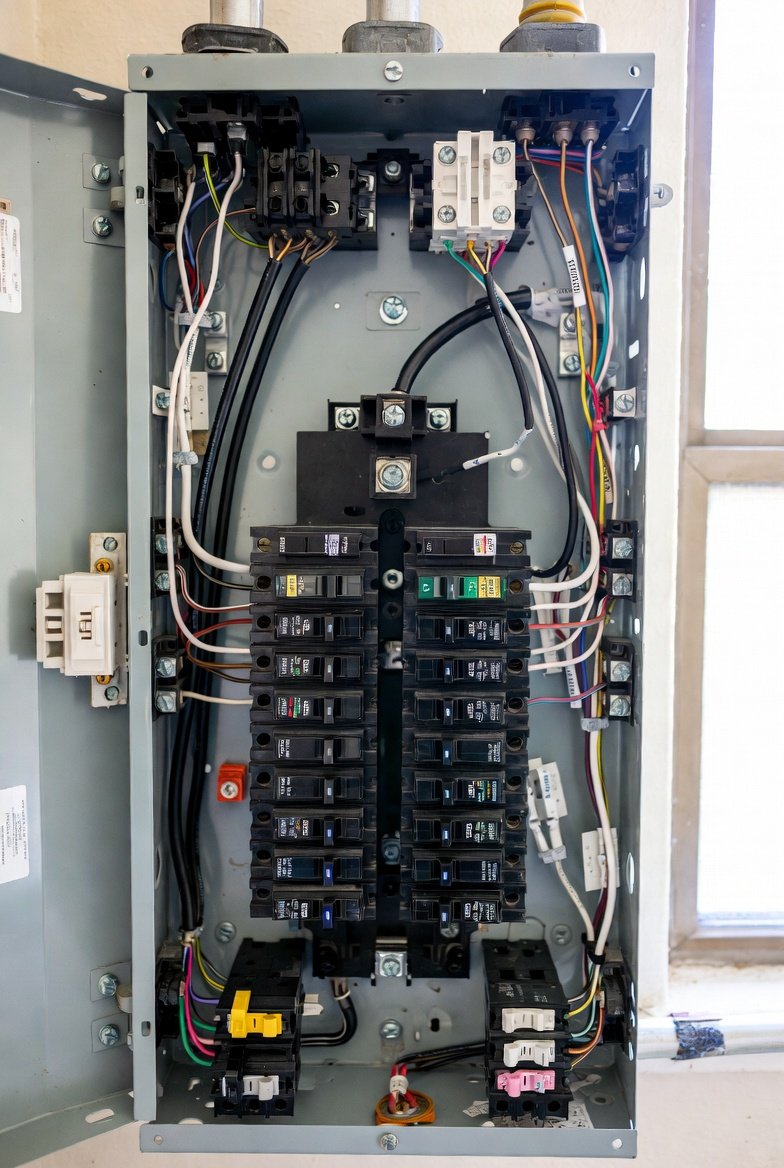
The largest cost increases usually happen when the work extends beyond replacing the panel itself.
A same-location, same-capacity replacement is easier to scope when the existing service equipment and conductors can remain in place. The project becomes more complicated when the electrician finds damaged wiring, service-equipment problems, relocation requirements, or conditions that require additional corrective work.
Existing Wiring and Conductor Problems
Removing the existing panel can expose conditions that were not obvious beforehand.
Possible complications include:
- damaged or heat-affected conductors
- conductors that do not reach appropriate termination points in the replacement equipment
- deteriorated insulation
- improper or crowded terminations
- previous electrical alterations that require correction
- obsolete or incompatible equipment
These conditions do not automatically mean the house needs to be rewired. Localized corrections needed to complete a panel replacement are different from a broader wiring project affecting substantial portions of the home.
If the work expands significantly beyond the panel and its immediate connections, that additional wiring scope should be identified separately in the estimate.
Grounding and Bonding Conditions
Grounding and bonding can also affect the project.
The electrician may need to evaluate existing grounding electrode conductors, bonding connections, service equipment, and related components to determine what work applies to the replacement.
The exact requirements depend on the installation, project scope, locally adopted electrical code, and the authority having jurisdiction. Homeowners should therefore avoid assuming that every panel replacement requires the same grounding or bonding changes.
Meter and Service Equipment
Costs can rise considerably when the project extends beyond the load center into the meter or other service equipment.
Additional work may involve:
- damaged or unsuitable meter equipment
- service conductors that require modification
- existing service components that cannot remain in place
- exterior service-equipment changes
- additional disconnect equipment
- work required by the serving utility
Once these components become part of the project, the homeowner is paying for more than a breaker-panel replacement. This is one of the main reasons apparently similar projects can produce very different estimates.
Utility Requirements
Utility involvement can add both coordination and scheduling requirements.
Depending on the service configuration and local utility procedures, the project may involve a scheduled disconnect, meter access, inspection or approval before reconnection, or changes to service equipment.
A contractor should make clear whether utility coordination is required and who is responsible for arranging it.
Does Moving the Electrical Panel Increase the Cost?
Yes. Relocating a panel can turn a relatively straightforward replacement into a much larger electrical project.
Moving the equipment may require changes to:
- branch-circuit conductors
- feeder or service conductors
- raceways
- meter or service equipment
- wall, siding, or other finishes
- grounding and bonding components
The proposed location must also satisfy applicable access and working-space requirements.
Because relocation introduces its own labor, material, and code considerations, it should be treated as a distinct project component rather than a minor add-on to every panel replacement.
Older, Obsolete, or Damaged Electrical Panels
Age alone does not determine whether an electrical panel should be replaced.
More useful questions include:
- Is the enclosure or internal equipment physically damaged?
- Is there evidence of corrosion or overheating?
- Are compatible replacement breakers and components still available?
- Is the equipment affected by a documented recall or product issue?
- Are there installation defects that cannot reasonably be corrected while keeping the existing equipment?
- Has an electrician or inspector identified a condition requiring corrective work?
Newer equipment is not automatically immune from defects. For example, the U.S. Consumer Product Safety Commission announced a 2022 recall involving certain Square D QO load centers because of a thermal burn and fire hazard. Depending on inspection findings, the remedy could involve repair or replacement. See the CPSC recall notice.
The better replacement decision is therefore based on the panel’s actual condition, equipment design, component availability, documented product history, and inspection findings rather than age alone.
Repair or Replace the Electrical Panel?
Not every electrical-panel problem requires complete replacement.
Some defects may be limited to an individual component or connection. Other conditions can make replacing the panel the more practical corrective path.
Replacement becomes more likely when:
- the enclosure or internal equipment is materially damaged
- bus components have been damaged
- corrosion has affected critical equipment
- compatible replacement components are unavailable
- the equipment is affected by a relevant recall or documented defect
- the required corrective work cannot reasonably be completed while retaining the existing panel
A localized component problem, however, does not automatically justify replacing the entire panel.
The correct scope depends on the specific defect and the condition of the remaining equipment. For the broader decision between replacing existing equipment and increasing the home’s electrical capacity, see our electrical panel upgrade vs. replacement guide.
How to Compare Electrical Panel Replacement Quotes
Section 1 explains why the underlying scope must match before prices can be compared. Once that scope is clear, look at how each contractor handles the parts of the job that can still create unexpected costs.
| Quote Detail | What to Clarify |
|---|---|
| Additional corrections | How unexpected conductor, termination, or equipment problems will be priced |
| Exclusions | Which electrical, utility, drywall, siding, or finish work is specifically excluded |
| Allowances | Whether any parts of the estimate are provisional rather than fixed |
| Scheduling responsibility | Who coordinates the permit, inspection, utility shutdown, and reconnection |
| Change orders | How additional work discovered after the project begins will be approved and documented |
| Warranty | What workmanship and equipment coverage is provided |
A lower initial price is not automatically a better value if substantial work is excluded or left as an open-ended allowance.
The goal is to compare estimates that describe the project with enough detail that you understand both the expected price and the circumstances that could change it.
Electrical Panel Replacement Quote Red Flags
A low price by itself is not a red flag.
More useful warning signs include:
- no clear description of the equipment being installed
- no explanation of permit or inspection responsibility
- unclear responsibility for utility coordination
- vague language about additional electrical corrections
- no written exclusions
- unclear warranty terms
- pressure to approve the project before the scope is clearly explained
A replacement proposal should make it possible to understand what the contractor intends to do before work begins.
How Long Does Electrical Panel Replacement Take?
A straightforward replacement may be completed within a working day, but the overall project timeline can extend beyond the physical installation.
Scheduling may be affected by:
- permit processing
- utility disconnect and reconnect scheduling
- inspection availability
- equipment availability
- service-equipment changes
- additional corrections discovered during the work
For that reason, a project involving several hours of electrical work can still require additional calendar time for coordination and approvals.
Our electrical panel upgrade inspection guide explains the inspection process in more detail.
Frequently Asked Questions
How much does it cost to replace a main electrical panel?
Published national estimates vary considerably because panel-replacement projects do not all include the same scope. A straightforward same-capacity replacement may fall toward the lower end of published ranges, while projects involving damaged conductors, service equipment, relocation, utility work, or other corrections can cost substantially more.
The most useful estimate is one that clearly identifies what equipment and additional work are included.
Is breaker box replacement the same as electrical panel replacement?
In common residential use, breaker box, breaker panel, electrical panel, and load center are often used to describe the home’s central circuit-distribution equipment.
The exact technical configuration can differ, but homeowners searching for breaker box replacement are generally referring to the type of project covered on this page.
Does electrical panel replacement require rewiring the house?
Not automatically.
An electrician may need to correct conductors or terminations associated with the panel replacement, but that is different from replacing substantial portions of the home’s branch-circuit wiring.
If widespread wiring problems are discovered, the additional work should be evaluated as a separate scope rather than assumed to be part of every panel replacement.
Does an old electrical panel always need to be replaced?
No. Age is one factor, but physical condition, equipment design, component availability, documented recalls, installation quality, and inspection findings are more useful indicators.
An older panel that remains serviceable is a different situation from equipment showing significant corrosion, heat damage, mechanical defects, or unavailable replacement components.
Can a Homeowner Replace an Electrical Panel?
Panel replacement involves service-level electrical work with serious shock and arc hazards.
Permit and licensing rules vary by jurisdiction, including whether an owner-occupant may legally perform particular electrical work on their own property. Local requirements should be verified rather than assumed.
For most homeowners, hiring a qualified electrical contractor is the practical approach because the project can involve utility coordination, permitting, inspection, service conductors, and equipment that may remain energized until the utility disconnects the service.
Does Homeowners Insurance Require Electrical Panel Replacement?
There is no single national panel-age threshold or replacement rule that applies to every insurance company.
An insurer may ask about electrical-system condition, equipment type, documented defects, or previous electrical upgrades during underwriting. Requirements vary by insurer, policy, and jurisdiction.
If coverage is a concern, confirm the requirements directly with the insurer before replacing equipment solely because of a generic age recommendation.
Bottom Line
Electrical panel replacement cost depends heavily on how much work extends beyond the panel itself.
A same-capacity replacement in the existing location can be relatively straightforward. The project becomes more involved when damaged conductors, grounding or bonding corrections, meter equipment, utility coordination, relocation, or other service components enter the scope.
Before choosing a contractor, make sure competing estimates describe the same project and explain how additional work will be handled if unexpected conditions are discovered.
The strongest replacement quote is not necessarily the lowest one. It is the quote that clearly identifies what will be replaced, what surrounding work is included, what is excluded, and what could legitimately change the final price.