
Electrical Panel Upgrade for EV Charger: Do You Actually Need One?
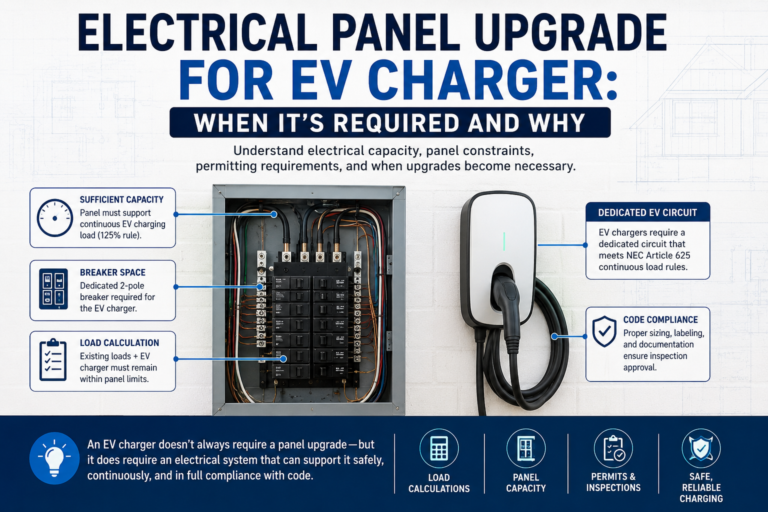
An electrical panel upgrade for EV charger installation is not automatically required just because you want Level 2 charging.
The decision depends on four separate questions:
- Charging load: How much charging power is actually being proposed?
- Electrical capacity: Can the existing electrical system support that additional load?
- Panel configuration: Can the existing equipment accommodate the required circuit?
- Alternatives: Can a suitable charging configuration or energy-management solution address the constraint without increasing service capacity?
| Existing Condition | Likely Direction |
|---|---|
| Enough capacity and suitable panel space | Add the EV charging circuit without a major panel or service change |
| Enough capacity but a breaker-space or distribution constraint | Evaluate an appropriate circuit-space or distribution solution |
| Available capacity is constrained but managed charging is appropriate | Evaluate compatible energy-management or load-management equipment |
| The existing panel has a separate equipment or condition problem | Evaluate the panel condition independently from the EV charging load |
| The required charging load cannot be accommodated by the existing service | Evaluate additional electrical capacity or broader service work |
The central distinction is simple: an EV charger adds electrical load, but that does not by itself prove that the home needs a new panel or larger electrical service.
Level 2 Charging Is Not One Fixed Electrical Load
Generic EV-panel advice often treats every Level 2 charger as though it places the same demand on a home.
It does not.
Residential Level 2 charging typically uses 240-volt service, but charging equipment can operate at different current levels.
For example, current Tesla Wall Connector documentation allows the equipment to be configured for several circuit sizes:
| Circuit Breaker | Maximum Charging Output | Approximate Power at 240V |
|---|---|---|
| 60A | 48A | 11.5 kW |
| 50A | 40A | 9.6 kW |
| 40A | 32A | 7.6 kW |
| 30A | 24A | 5.7 kW |
| 20A | 16A | 3.8 kW |
Those values are one manufacturer’s current equipment example, not a universal sizing table for every EV charger. The EVSE, circuit design, conductors, overcurrent protection, vehicle capability, and applicable electrical requirements all have to match the installation.
The useful takeaway is broader:
The charging load being requested can materially affect whether the existing electrical system can accommodate the project.
EV Charging Is Treated as a Sustained Electrical Load
EV charging can draw substantial current for extended periods, so its electrical requirements cannot be evaluated as though the equipment only reaches its rated load briefly.
This affects branch-circuit design and the way the proposed charging load is considered when available electrical capacity is evaluated.
The U.S. Department of Energy, for example, describes a common residential Level 2 configuration in which 30-amp charging equipment uses a dedicated 40-amp circuit to comply with NEC Article 625 requirements.
The homeowner does not need to reduce that requirement to one rule of thumb. What matters is that the EVSE output, branch circuit, and available household electrical capacity must all be evaluated together.
For an overview of residential charging levels, see the U.S. Department of Energy Alternative Fuels Data Center.
Start With the Proposed Charging Load and a Load Assessment
Before approving an electrical panel upgrade for EV charger installation, ask what charging load is being designed for and what electrical-load assessment supports the recommendation.
The assessment must consider the proposed EV load in the context of the home’s other electrical demand.
Major existing loads may include:
- electric space heating or heat pumps
- electric water heating
- electric cooking equipment
- electric dryers
- air-conditioning equipment
- other substantial permanently connected loads
A home with 100-amp service does not automatically require a 200-amp upgrade because an EV charger is being added.
Likewise, a 200-amp service rating does not establish that every charging configuration can be added without evaluating the home’s existing loads.
The recommendation should follow the electrical assessment rather than the service rating alone.
Our electrical panel load calculation guide covers that decision in more detail.
Breaker Space Is Not the Same as Electrical Capacity
A residential Level 2 charging installation commonly requires an appropriate 240-volt branch circuit, which creates a physical panel-space question as well as a capacity question.
Those are not the same constraint.
A home can have sufficient electrical capacity for the proposed charging load but lack a suitable breaker arrangement in the existing panel.
The opposite can also occur: unused breaker positions may remain even though the available electrical capacity is insufficient for the proposed additional load.
If physical panel space is the problem, the appropriate solution depends on the existing equipment, its listed configurations, available distribution options, and local requirements. Depending on the installation, the solution may involve an approved breaker configuration, circuit reorganization, a subpanel, or another distribution change.
A panel that appears full is therefore not, by itself, evidence that the home’s electrical service must be increased.
A Lower Charging Configuration Can Change the Decision
The highest charging rate supported by an EVSE is not necessarily the charging rate every household needs.
If a vehicle is normally parked overnight and needs to recover only its typical daily driving, a lower Level 2 charging rate may still provide sufficient charging time.
Some current charging equipment can be commissioned at different output levels to match the available circuit and electrical supply.
That makes one question worth answering before approving a major capacity increase:
What charging rate does the household actually need?
A lower output is not a shortcut around proper electrical design. The EVSE, branch circuit, overcurrent protection, conductors, vehicle, and applicable requirements still have to support the selected configuration.
But the charging requirement should be established before assuming that maximum equipment output—and the electrical work needed to support it—is necessary.
Energy Management Can Sometimes Avoid a Traditional Panel Upgrade
When available electrical capacity is constrained, compatible energy-management equipment can provide another option in suitable installations.
These systems can monitor household electrical demand and adjust EV charging so that the combined load remains within an established limit.
For example, charging output can decrease when other large household loads are operating and increase again as capacity becomes available.
This is already used in current residential charging systems. Tesla’s Dynamic Power Management monitors panel load and adjusts Wall Connector charging output in real time. PG&E’s ChargeBoost program likewise offers qualifying customers a way to use Level 2 charging without a conventional main-panel upgrade.
See PG&E’s current ChargeBoost program.
These examples do not mean energy management works for every home. Equipment compatibility, system design, local code requirements, utility rules, and approval by the applicable authority all matter.
The important point is that constrained electrical capacity does not automatically make increased service amperage the only possible solution.
When Broader Panel or Service Work May Be Necessary
A larger electrical project becomes more likely when the charging load the household reasonably needs cannot be accommodated by the existing system and an appropriate lower-scope solution is not available.
The additional work may be driven by:
- insufficient available electrical capacity for the required charging load
- existing panel equipment that cannot appropriately accommodate the required circuit
- a separate condition or equipment problem affecting the existing panel
- a capacity increase that requires changes to service conductors or other service equipment
- meter, utility, or service-side changes associated with increasing capacity
The next question is therefore not simply, “Do I need a panel upgrade?” It is what part of the electrical system actually has to change.
A panel replacement, a distribution change, an increase in available capacity, and a broader service upgrade are different scopes of work.
Our electrical panel upgrade vs replacement guide explains those distinctions.
If the project truly requires moving from approximately 100-amp to 200-amp service, see our 200 amp panel upgrade cost guide.
Once the EV-specific electrical scope has been established, our panel upgrade for EV charger cost guide covers the pricing side of the decision.
Panel Work and Service Upgrades Are Not the Same Project
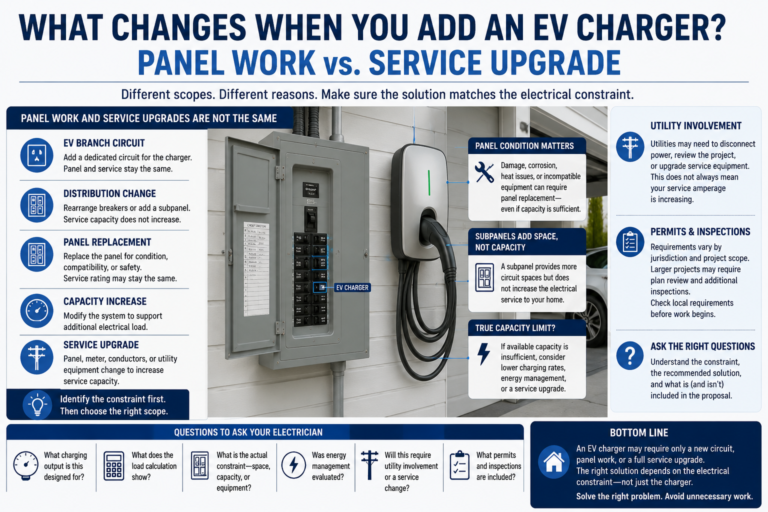
Once an EV charging assessment identifies an electrical constraint, the next step is to determine which part of the system actually has to change.
Several different projects are commonly described as a “panel upgrade,” even though they do not accomplish the same thing.
| Electrical Scope | What Actually Changes |
|---|---|
| EV branch circuit | A charging circuit is added while the existing panel and service remain in place |
| Distribution change | Breaker arrangement, circuit distribution, or a subpanel changes without necessarily increasing service capacity |
| Panel replacement | The existing panel equipment is replaced, potentially while retaining the same service rating |
| Capacity increase | The electrical system is modified so it can support additional load |
| Broader service upgrade | Panel, meter, service conductors, disconnect equipment, or utility-facing components may change as part of increasing service capacity |
Replacing the breaker panel does not automatically mean the home’s incoming electrical service has been increased. Conversely, increasing service capacity can require work well beyond the breaker panel.
An EV-related estimate should therefore identify the equipment and service changes being proposed rather than using “panel upgrade” as a catch-all description.
Panel Condition Can Change the Required Scope
A home may have sufficient electrical capacity for the proposed EV charging load while the existing panel has a separate equipment or condition problem.
Examples can include significant corrosion, confirmed heat damage, damaged internal components, equipment incompatibility, or other deficiencies that prevent the existing panel from appropriately accommodating the new work.
That distinction matters because replacing a defective or unsuitable panel is not the same as increasing the home’s electrical service capacity.
If the panel itself requires replacement, see our electrical panel replacement cost guide.
A Subpanel Does Not Increase Electrical Service Capacity
A subpanel can provide additional locations for branch circuits and help solve certain distribution-space problems.
It does not, by itself, increase the amount of electrical service available to the home.
The loads supplied through the subpanel still contribute to the demand served by the existing electrical system.
That makes a subpanel potentially useful when distribution space is the constraint, but it does not automatically solve a shortage of available electrical capacity.
For more on that scope, see our electrical subpanel cost guide.
Utility Involvement Does Not Automatically Mean More Amperage
An electric utility may become involved when work affects utility-connected service equipment, requires power to be disconnected and reconnected, or changes the customer’s electrical service.
Utility involvement alone does not establish that the home’s service rating is increasing.
For example, some panel or service-equipment work can require a utility disconnect and reconnect even when the final service rating remains unchanged.
A true service-capacity increase may involve a broader scope, potentially including:
- service conductors
- meter or meter-socket equipment
- service disconnect equipment
- overhead or underground service components
- utility engineering or service review
The exact division of work between the electrician, homeowner, utility, and local authority depends on the utility and jurisdiction.
PG&E, for example, currently directs homeowners considering Level 2 EV charging to have an electrician assess the home’s electrical system and uses its service-planning process when qualifying panel or utility-service work is involved.
See PG&E’s current EV electrical-service guidance.
Permits and Inspection Requirements Depend on the Project
EV charging electrical work may require permits and inspections, but the exact process depends on the jurisdiction and scope of work.
A project limited to a charging circuit can follow a different review path from one that also changes:
- the electrical panel
- service capacity
- meter or service equipment
- distribution equipment
- utility-connected components
Seattle provides a useful example. Its current electrical-permit guidance requires permits for electrical wiring that is installed, altered, extended, or connected to electrical equipment, while certain projects require additional plan review. The city also publishes specific guidance for residential EV charger installations.
That is why there is no single national checklist describing exactly what every EV-charger inspector will request. The locally adopted electrical code, amendments, permitting process, equipment, and project scope all matter.
For more detail, see our electrical panel upgrade permit guide.
Questions to Ask Before Approving an EV-Related Panel Upgrade
If major panel or service work is recommended, the proposal should explain the electrical constraint that makes that work necessary.
- What charging output is the installation being designed for?
- What does the electrical-load assessment show?
- Is the constraint breaker space, panel condition, available capacity, or service equipment?
- Would the existing panel need replacement even without the EV charger?
- Is the home’s service rating actually increasing?
- Would another supported charging configuration meet the household’s charging needs?
- Was an appropriate energy-management option evaluated?
- Will the project require utility review or disconnect/reconnect work?
- What permits and inspections are included in the proposal?
A larger replacement panel is not, by itself, evidence that a larger electrical service is necessary.
The proposed work should solve an identified electrical constraint.
Define the Electrical Scope Before Comparing Prices
An EV branch circuit, panel replacement, energy-management installation, and full service-capacity increase are different projects. Their prices should not be compared as though they provide the same solution.
First determine what work is actually required. Then compare estimates that include equivalent electrical scope.
If panel or service work is necessary, our panel upgrade for EV charger cost guide explains the EV-specific pricing factors.
Frequently Asked Questions
Can an EV Charger Require Panel Replacement Without a Service Upgrade?
Yes. The home may have sufficient service capacity for the proposed charging load while the existing panel has a separate condition, compatibility, or equipment problem that requires replacement.
Replacing that panel does not necessarily increase the home’s service rating.
Does Adding a Subpanel Give the Home More Electrical Capacity?
No. A subpanel adds distribution capability downstream of the existing service but does not by itself increase the amount of electrical service available to the home.
Does Utility Involvement Mean the Home Is Being Upgraded to 200 Amps?
No. A utility can be involved because electrical service must be disconnected and reconnected or because utility-connected equipment is affected. Whether the home’s service capacity is actually increasing is a separate question.
What Should an EV-Related Panel Upgrade Quote Explain?
The proposal should identify the electrical constraint, the equipment being changed, whether service capacity is increasing, expected utility involvement, and the permit and inspection scope included in the price.
Bottom Line
An EV charger does not create one universal electrical-panel project.
A home may need only a charging circuit, a distribution change, replacement of unsuitable panel equipment, additional electrical capacity, or broader service work.
Those scopes solve different problems and can involve very different amounts of work.
Before approving an electrical panel upgrade for an EV charger, identify the constraint first and make sure the proposed work directly solves it.