
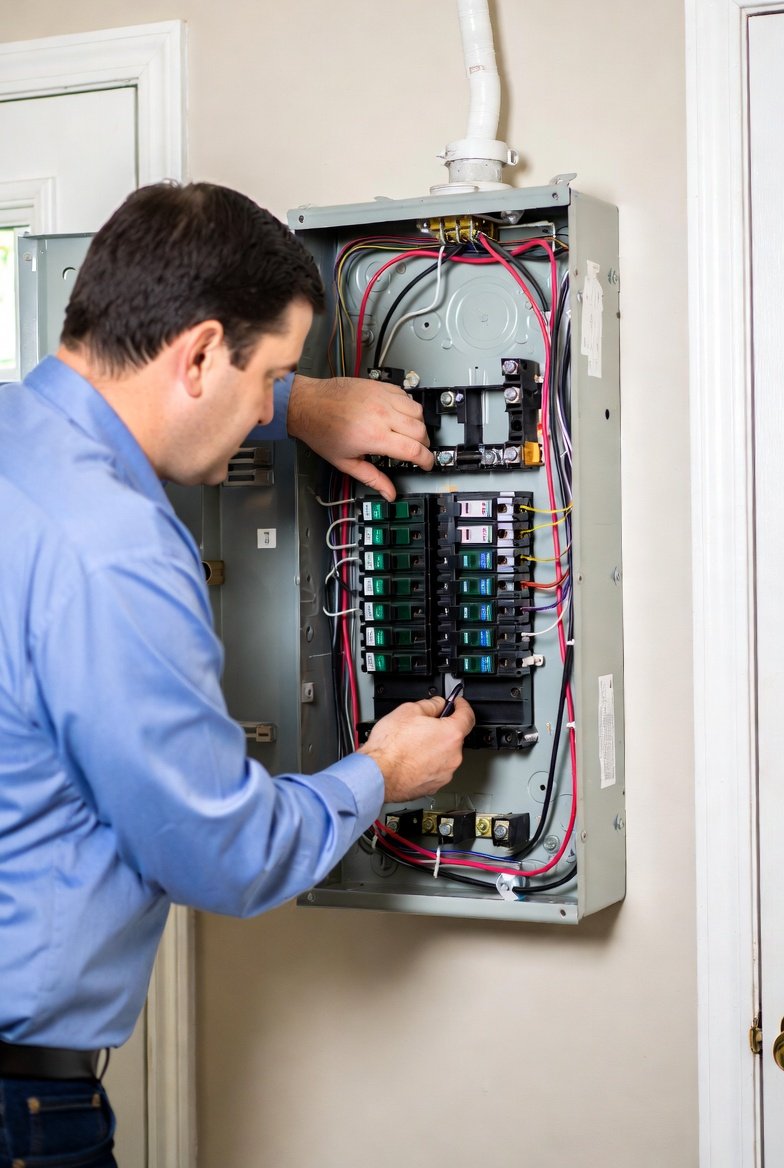
Rebates are not automatic.
They are conditional.
They are documentation-driven.
They are sequence-sensitive.
Most rebate denials happen for one reason:
The panel was installed before eligibility was confirmed.
Utilities require pre-approval.
Tax credits require qualifying equipment.
Inspectors require compliance.
If those three do not align, incentives disappear.
This page explains what qualifies, what does not, how stacking works, and how to protect residential electrification incentives tied to panel capacity upgrades.
What Types of Electrical Panel Upgrade Rebates Exist
Panel capacity upgrade incentives typically fall into three layers:
- Federal energy-efficient home rebates (Section 25C tax credit)
- State residential electrification incentives
- Utility EV rebate eligibility programs
They do not function the same way.
Federal Tax Credit for Electrical Panel Upgrades (Section 25C)
The IRS Energy Efficient Home Improvement Credit allows:
- 30% of eligible costs
- Up to $600 annually for panel upgrades
- Must enable qualifying energy-efficient equipment
Qualifying triggers typically include:
- Heat pump installation
- Electric HVAC conversion
- Electric water heater upgrade
- Other electrification measures
A panel replacement without qualifying equipment does not qualify.
IRS guidance:
home improvement
Energy.gov overview:
home upgrades
Do EV or Heat Pump Upgrades Make You Eligible for Incentives?
Yes — often.
When a panel upgrade is required to support:
- EV charger installation
- Heat pump conversion
- Whole-home electrification
- Solar interconnection
It may qualify for federal and utility incentives.
EV readiness cost breakdown:
EV-Charger
Solar upgrade requirements:
Upgrade requirements
Load calculation reference:
Load calculation guide
Scope Tier Structure — Rebates Depend on Upgrade Level
Upgrade Tier | Scope | Incentive Potential | Risk Level |
Tier 1 – Replacement Only | Replace aging Panelboard | Low | Minimal incentive |
Tier 2 – Capacity Increase | 100A → 200A service | Moderate | Depends on electrification |
Tier 3 – Electrification Enablement | Supports EV or Heat Pump | High | Strong stacking potential |
Tier 4 – Utility + Meter Upgrade | Full infrastructure expansion | High | Requires coordination |
Rebates typically apply in Tier 3 and Tier 4 scenarios.
Rebate Stacking — Federal + State + Utility
Stacking is possible but must avoid double counting.
Incentive Type | Stackable with Federal Credit | Notes |
State Electrification Rebate | Yes | Income-tier rules may apply |
Utility EV Rebate | Yes | Often requires pre-approval |
Manufacturer Incentive | Yes | Separate from public incentives |
 Warning: You cannot claim multiple incentives on the same cost portion unless program rules allow cost allocation.
Combined Savings Example
Upgrade | Base Cost | Utility Rebate | State Incentive | Federal Credit | Net Cost |
200A + Heat Pump | $3,800 | $1,000 | $500 | $600 | $1,700 |
EV-Ready Upgrade | $5,200 | $2,500 | $0 | $600 | $2,100 |
Basic Replacement | $3,200 | $0 | $0 | $0 | $3,200 |
Full cost guide:
Panel upgrade cost
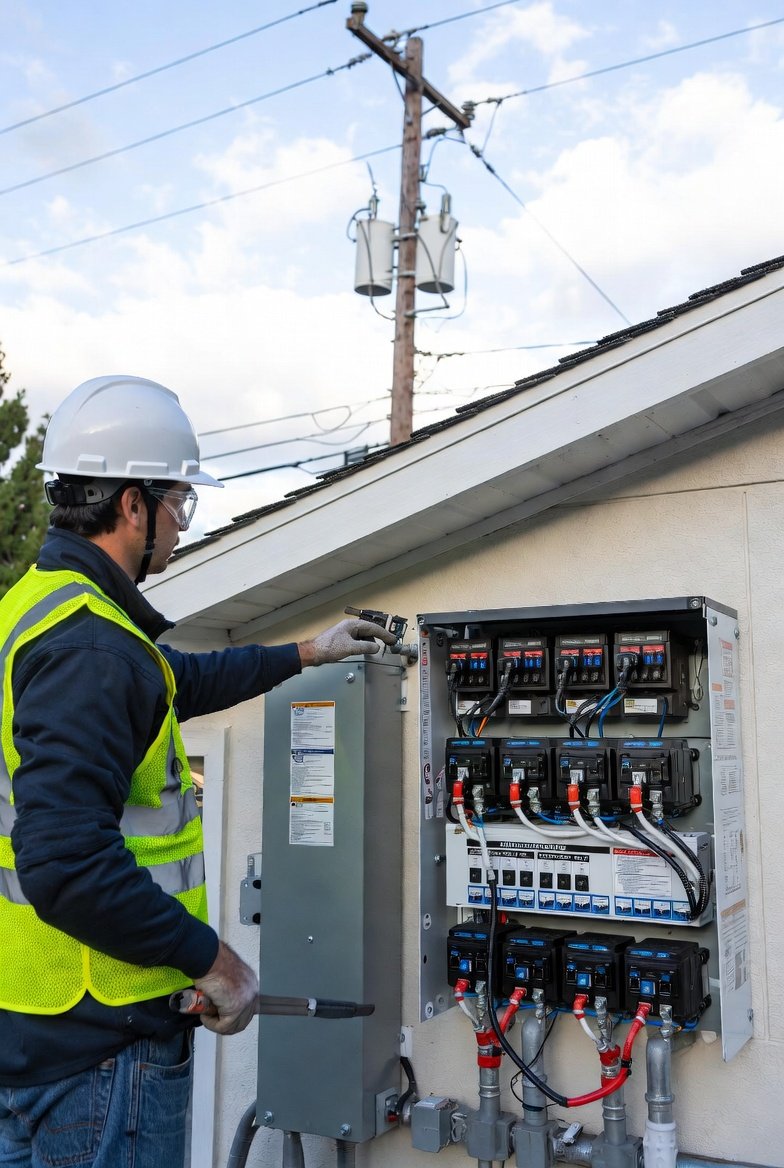
How to Claim Electrical Panel Upgrade Rebates — Step-by-Step
- Determine load requirement
- Identify qualifying electrification equipment
- Confirm federal eligibility
- Check state energy-efficient home rebates
- Apply for utility pre-approval (if required)
- Pull permit
- Install panel
- Pass inspection
- Submit documentation
- Claim tax credit on Form 5695
Pre-approval must occur before installation for many utility programs.
Inspection Disqualifiers That Jeopardize Incentives
Issue | Impact | Fix Required |
Improper grounding | High | Bonding correction |
Breaker incompatibility | High | Listed breakers only |
Clearance violation | Moderate | Remove obstruction |
Double-tapping | Moderate | Re-terminate |
No permit | Severe | Retroactive approval |
Inspectors rarely fail for aesthetics.
They fail for safety compliance.
Without final approval, documentation may be insufficient.
Utility Coordination Risks
Certain rebate programs require:
- Service disconnect scheduling
- Transformer capacity review
- Utility inspection before energization
Delays may impact:
- Solar PTO approval
- EV charger activation
- Final rebate disbursement
Failing to coordinate can extend timelines 2–4 weeks.
When Panel Upgrade Rebates Do NOT Apply
Rebates typically do not apply when:
- Replacing panel due to age alone
- Cosmetic resale preparation
- No electrification equipment installed
- Work performed without permit
Retroactive permit approval may jeopardize stacking eligibility.
Pro Tips — Common Mistakes That Cause Denials
- Installing before confirming eligibility
- Failing to apply for utility pre-approval
- Not itemizing invoice cost breakdown
- Mixing qualifying and non-qualifying expenses
- Missing inspection documentation
Consult a licensed electrician and tax professional for verification.
Decision Grid — Should You Research Incentives?
Situation | Rebate Likely? | Action |
Installing heat pump | Yes | Research stacking immediately |
Installing EV charger | Yes | Apply for pre-approval |
Replacing obsolete panel only | Unlikely | Confirm before assuming |
Preparing for future electrification | Possible | Confirm Tier 2 eligibility |
Checklist — Documentation Required
- Permit record
- Final inspection approval
- Itemized contractor invoice
- Equipment model numbers
- Pre-approval confirmation (if required)
- Tax credit filing form
Key Takeaways
- Panel upgrades qualify when enabling electrification.
- Sequence protects incentives.
- Pre-approval is critical for utility EV rebates.
- Inspection compliance supports documentation.
- Stacking is possible with cost allocation clarity.
Rebates reduce net cost significantly — when controlled.
Assumption eliminates them.
Frequently Asked Questions
Can I claim a rebate after installation?
Some utility programs allow post-installation submission, but many require pre-approval.
What if my utility denies my rebate?
Review denial reason. Often documentation or timing is the issue. Appeals may be possible.
Does a solar-ready panel affect rebate eligibility?
Yes. If required for solar interconnection, it may support stacking eligibility.
Are panel capacity upgrade incentives income-based?
Many state programs include income-tier requirements.