
Most panel upgrades take one day to install.
Most panel upgrades take weeks to finish.
Those two statements are both true.
The install is mechanical.
The timeline is administrative.
If you don’t understand the difference, you can misjudge your disruption window by weeks.
Electrical Panel Upgrade Timeline Snapshot
Install Time: 4–8 hours (typical like-for-like swap)
Power-Off Window: 4–10 hours common
Permit Processing: Days to 2+ weeks (jurisdiction dependent)
Inspection Approval: Same day to several days
Utility Reconnect: Hours to days after release
Total Calendar Timeline: 1–4 weeks typical (longer if service changes)
That’s the honest baseline.
Now let’s break it down properly.
Clock #1: The Install Day (Hours)
If you are replacing a panel with the same amperage in the same location:
- Electricians commonly complete the physical swap in one workday.
- Power is off during the majority of that window.
- Work includes transferring circuits, labeling, grounding verification, and testing.
If the scope expands (service upgrade, relocation, grounding corrections), install hours increase—but rarely exceed a full day or two.
Install time is predictable.
Approval time is not.
If you are unsure whether your upgrade is like-for-like or a full service increase, review:
100a vs 200a
Clock #2: The Approval Chain (Days to Weeks)
This is where projects stretch.
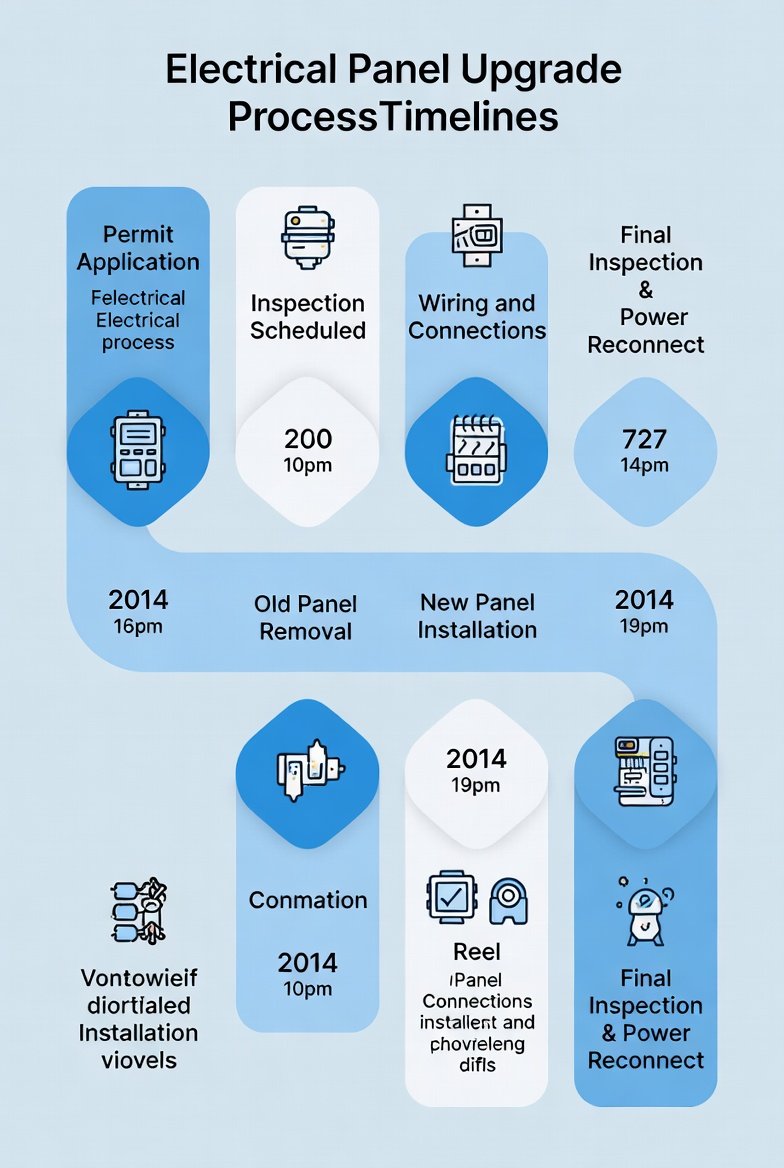
The real sequence:
- Permit issued
- Installation completed
- Inspection performed
- Inspector passes work
- Release transmitted
- Utility reconnects service
Power restoration depends on step 4.
If inspection fails, reconnect does not happen.
This is why experienced electricians focus heavily on grounding, bonding, labeling, and clearance compliance. Inspectors rarely fail panels for speed—they fail them for technical errors.
If you want to understand common compliance triggers, see:
electrical permit guide
How Long Will My Power Be Off?
This is the most important question for homeowners.
Standard panel replacement
- Power is typically off for most of install day.
- Refrigeration, Wi-Fi, alarms, and HVAC will be offline.
Service upgrade
- Power may be off longer depending on disconnect/reconnect coordination.
- If inspection occurs late in the day, reconnect may roll to the next utility window.
- In rare cases, overnight outage can occur if approval timing misses utility dispatch cutoff.
Utility coordination is the unpredictable variable.
If you are stacking EV or heat pump upgrades with the panel, that may change scope and scheduling:
EV-Charger cost
Panel upgrade for heat pump
Scope-Based Timeline Matrix (Severity View)
Scope Type | Install Hours | Inspection Delay Risk | Utility Delay Risk | Total Timeline Risk |
Like-for-like panel swap | 4–8 hrs | Low | Low | Low |
Panel swap + grounding fixes | 6–10 hrs | Moderate | Low | Moderate |
100A → 200A service upgrade | 6–12 hrs | Moderate | Moderate | Medium–High |
Meter relocation | 1 day+ | Moderate | High | High |
Underground service modification | 1–2 days | Moderate | Very High | Very High |
This is the difference between “one-day job” and “three-week process.”
If your load calculation indicates margin issues, that may move you from Low to Medium risk quickly:
Load calculation guide
Timeline Severity Drivers (Delay Adders)
Trigger | Typical Time Impact |
Permit backlog | +Several days to 2+ weeks |
Failed inspection | +1–10 days (correction + re-inspection) |
Utility scheduling backlog | +Days to weeks |
Service mast repair requirement | +Several days |
Meter base relocation | +1–3 weeks |
Underground redesign review | +Weeks |
Transformer upgrade requirement | +Utility-dependent |
Most delays are not electrical labor delays.
They are approval chain delays.
Utility Reconnect Reality
Utilities typically will not reconnect service until inspection approval is formally transmitted.
Important realities:
- Reconnect may occur same day in efficient jurisdictions.
- Late-day inspection passes can push reconnect to next business day.
- Friday upgrades can spill into Monday reconnect.
- Utility backlog can override electrician scheduling entirely.
Install day ends when work is done.
Project ends when reconnect is complete.
Those are not the same moment.
Best Case vs Typical vs Worst Case
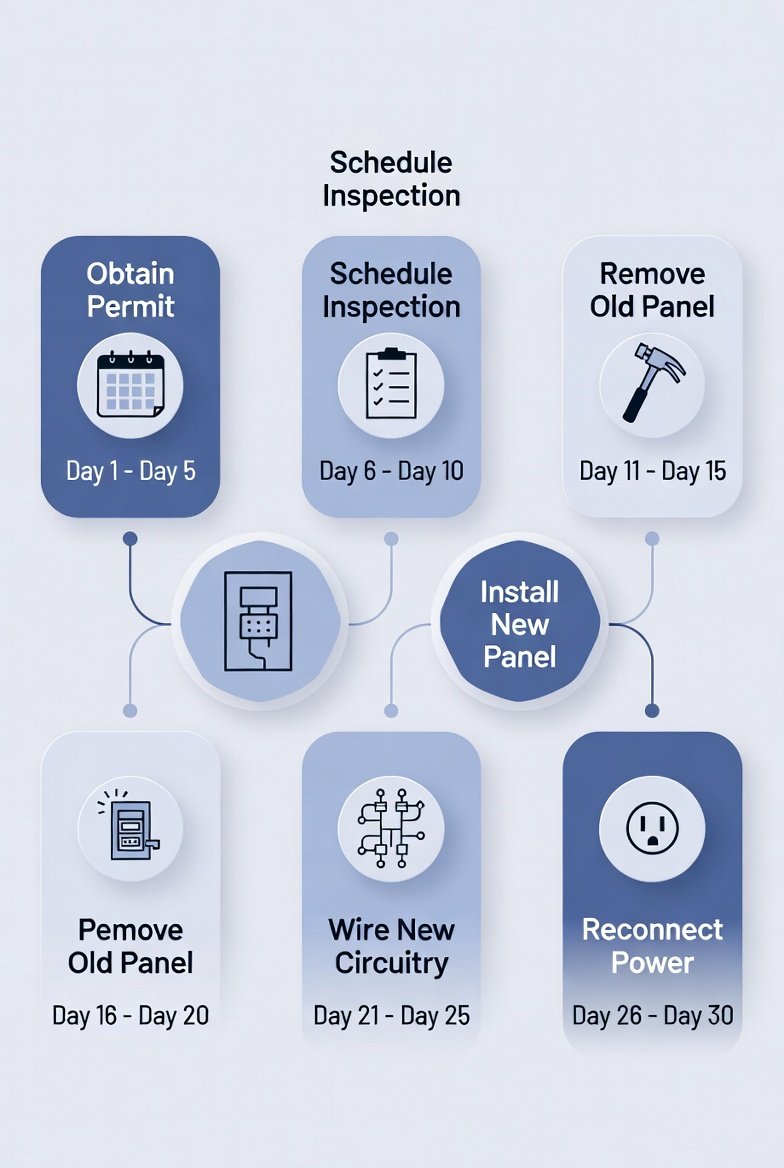
Best Case
- Like-for-like swap
- Fast permit issuance
- Same-day inspection
- Same-day reconnect
Calendar Time: 1–2 weeks
Power Off: One workday
Typical Case
- Permit takes several days
- Inspection next business day
- Utility reconnect within 1–3 days
Calendar Time: 2–3 weeks
Power Off: One workday
Worst Case
- Service upgrade
- Permit delay
- Inspection correction
- Utility scheduling backlog
Calendar Time: 3–6+ weeks
Power Off: One extended day (occasionally longer)
Worst cases are administrative, not mechanical.
Timeline Compression Strategy
If you want the shortest possible disruption:
- Confirm service size before permit submission.
- Complete load calculation early.
- Address grounding/bonding upgrades proactively.
- Avoid late-week installations when reconnect risk matters.
- Confirm utility coordination window before shutdown.
- Bundle electrification projects under one permit cycle if planned.
Shorter timelines come from fewer surprises.
When Projects Extend by Design
Sometimes the longer timeline is intentional.
Homeowners planning:
- EV charger installation
- Heat pump conversion
- Battery storage integration
may coordinate upgrades under one permit.
That increases calendar time slightly—but reduces total disruption across multiple future projects.
If battery integration is on your roadmap, review scope implications here:
Panel upgrade for home battery
Inspection Approval: The True Gatekeeper
No reconnect happens without inspection approval.
The fastest panel upgrade is the one that:
- Passes first inspection
- Avoids correction cycles
- Coordinates reconnect timing before power is shut down
Inspectors are not looking for aesthetics.
They are looking for safety compliance.
The calendar moves only when compliance clears.
Final Verdict
An electrical panel upgrade typically involves:
- 4–8 hours of hands-on installation
- 1–4 weeks of total calendar time
- One primary power outage window
Install time is consistent.
Approval time is variable.
If your upgrade is straightforward and permitted correctly, disruption is minimal.
If your upgrade includes service changes, relocation, or electrification stacking, plan margin into your schedule.
The fastest projects are the ones that pass inspection cleanly the first time.
Frequently Asked Questions
How long does the actual panel replacement take?
Most like-for-like replacements are completed within one workday, commonly 4–8 hours.
How long will my power be off?
Typically most of the installation day. Service upgrades can extend downtime depending on inspection and reconnect timing.
Why does the full timeline take weeks?
Permit processing, inspection approval, and utility scheduling determine the total calendar time.
Can a failed inspection delay reconnect?
Yes. Corrections must be completed and approved before utilities restore service in most jurisdictions.
Is a service upgrade slower than a simple panel replacement?
Yes. Service upgrades add utility coordination and scheduling layers that extend timeline risk.