
Electrical Panel Upgrade Before Selling House — Timing Strategy
Timing matters more than most homeowners realize.
Upgrade BEFORE Listing When:
- Panel is visibly outdated
- Inspector pushback is predictable
- Insurance concerns already surfaced
- Market favors move-in-ready homes
Pre-list upgrades reduce negotiation drama.
Upgrade AFTER Offer When:
- Market is extremely hot
- Buyer concessions are manageable
- You want to offer repair credit instead
Sometimes offering escrow credit is smarter than pre-spending capital.
Wrong Choice Penalty (Critical Decision Layer)
This is where sellers miscalculate.
 If You Upgrade When It Wasn’t Necessary:
- You may over-improve relative to neighborhood comps
- You may not recoup the cost
- Capital could have been used for higher-ROI improvements (kitchen, curb appeal)
If You Don’t Upgrade When You Should:
- Buyer credit exceeds upgrade cost
- Inspection delays
- Insurance complications
- Weaker offers
- Deal collapse risk
The penalty of inaction can exceed the cost of action.
Geographic Nuance: Where Panel Upgrades Matter Most
ROI varies by location.
Higher ROI Markets:
- EV-heavy states
- Electrification-forward cities
- Aging housing stock regions
- Strict inspection climates
- Insurance-heavy markets
Lower ROI Markets:
- Entry-level price-sensitive regions
- Areas where 100A is still common
- Seller-dominant hot markets
Value impact is contextual.
Cost vs Competitive Position Modeling
Typical panel upgrade cost: upgrade cost
Example scenario:
Upgrade cost: $4,500
Possible outcomes:
- $0 direct price bump but smoother transaction
- Avoid $6,000 buyer credit request
- Prevent $5,000 price reduction
- Stronger buyer confidence
- Faster closing
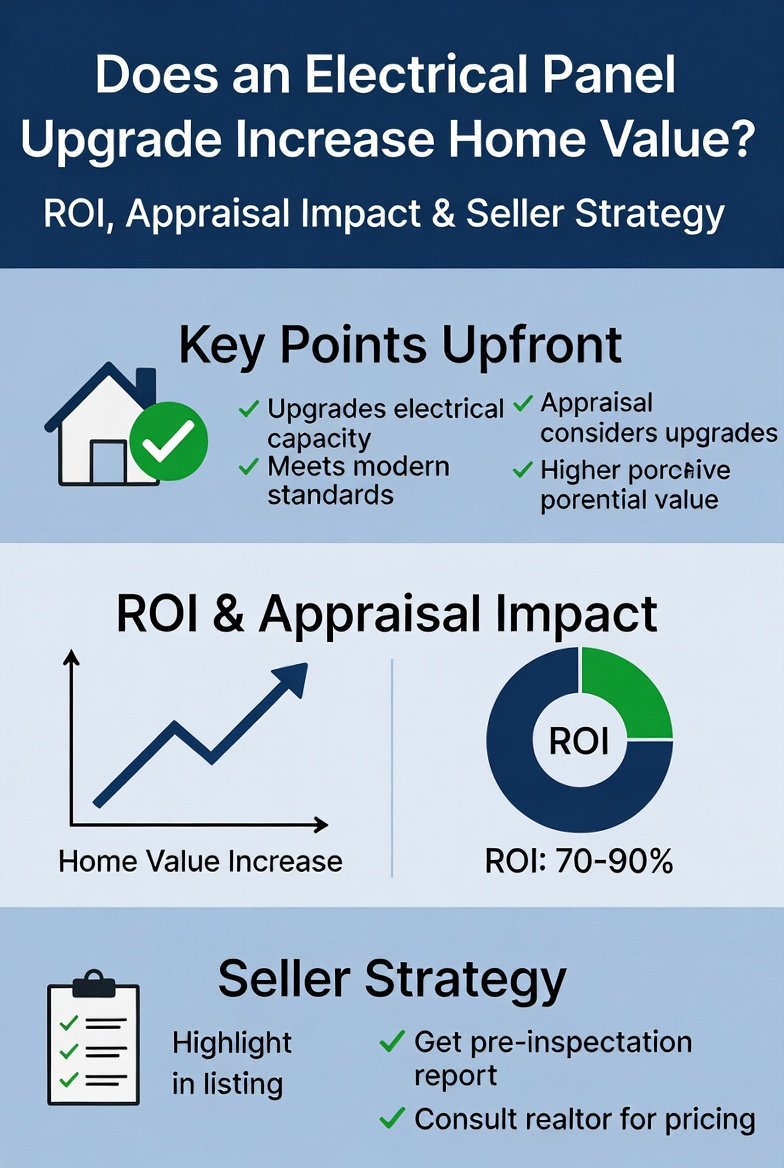
In most cases, the upgrade strengthens transaction position rather than inflating listing price.
Competitive Listing Advantage
Buyers compare homes quickly.
If your listing says:
- “New 200A electrical panel installed”
- “Electrical system updated”
- “Move-in ready electrical capacity”
It removes hesitation.
Buyers rarely pay extra for upgrades.
But they absolutely hesitate over outdated systems.
Removing hesitation increases offer strength.
When It’s Probably NOT Worth It
A panel upgrade may not increase value if:
- The panel is already modern and compliant
- No capacity limitation exists
- Market comps also have 100A service
- The home’s bigger value drivers are elsewhere
- Buyers are strictly price-driven
In these cases, ROI may be marginal.
Seller-Level Decision Framework
Ask yourself:
 Is my panel outdated relative to comps?
 Will it trigger inspection friction?
 Will buyers expect EV-ready capacity?
 Am I trying to market this as a fully modernized home?
If you answer yes to two or more, upgrading is often strategic.
If you answer no to most, it may not move the needle.
Upgrade vs Replacement Clarification
If the panel is unsafe or obsolete, you may not be in “ROI decision” territory.
You may be in “required correction” territory.
Use this distinction: upgrade vs replacement
And confirm capacity needs: calculation for upgrade
Final Verdict
An electrical panel upgrade:
- Rarely creates dramatic standalone price jumps.
- Often protects value by preventing negotiation losses.
- Reduces inspection and insurance friction.
- Improves competitive positioning in modern markets.
It is a risk management improvement more than a cosmetic one.
The smartest question isn’t:
“Will I make money on this?”
It’s:
“Will this prevent me from losing leverage?”
That’s where real ROI lives.
FAQs
Does upgrading to 200 amps increase home value?
It can improve competitiveness and prevent negotiation losses, but it does not guarantee a direct dollar-for-dollar price increase.
Is a panel upgrade worth it before selling?
Often yes if the existing panel is outdated, likely to trigger inspection objections, or misaligned with local market expectations.
Do appraisers add value for panel upgrades?
Appraisers consider overall system modernization and condition but do not typically assign a fixed price increase solely for a panel upgrade.
Can a panel upgrade help with insurance approval?
In some cases, yes—especially if insurers flag older equipment or request updated documentation.
Will upgrading make my home sell faster?
It can reduce buyer hesitation and inspection friction, which may lead to stronger offers and smoother closings.