
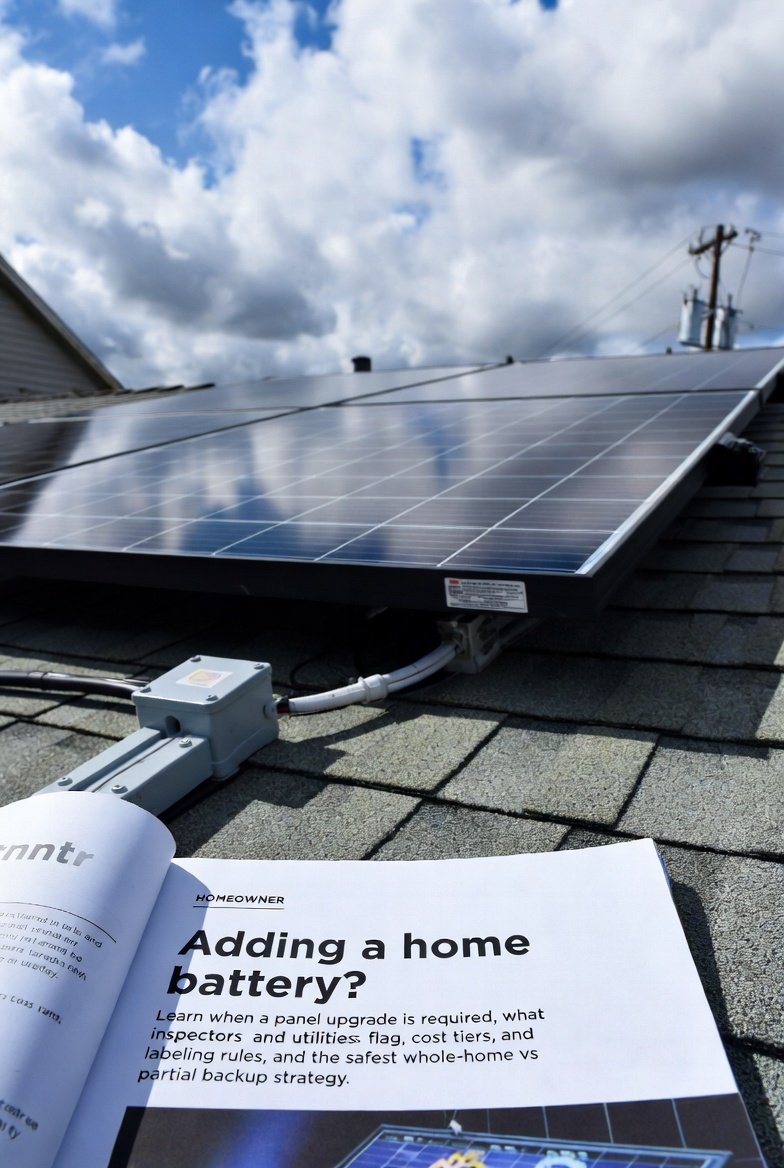
A battery install is approved twice.
First by the inspector.
Then by the utility.
If either rejects the electrical interface, the system stays dark.
Home batteries bring a second power source into the home. That changes how the main panel, service equipment, and disconnecting means are evaluated. Inspectors focus on interconnection capacity, labeling clarity, bonding scheme, and listed equipment — not brand marketing.
When those don’t align, panel upgrades become the cleanest fix.
What Actually Forces a Panel Upgrade in Battery Projects?
A home battery does not automatically require a 200-amp service.
Upgrades are typically triggered by one of these structural realities:
- Service amperage is 100A and whole-home backup is planned
- Main panel is full (no breaker space)
- Interconnection math exceeds panel limits
- Panel condition or brand creates insurance friction
- Battery is stacked with solar, EV, or heat pump electrification
If you are unsure how your service size affects flexibility, review the baseline comparison:
100av panel
Panel math determines compliance.
Inspection enforces it.
Whole-Home vs Partial Backup — The Decision That Controls Everything
Before discussing upgrades, clarify your backup intent.
Path A: Whole-Home Backup
- Most circuits supported
- Higher interconnection stress
- Greater chance of service upgrade
- More utility coordination
Path B: Partial Backup (Critical Loads Panel)
- Selected circuits supported
- Lower stress on main service
- Often avoids full service upgrade
- Cleaner inspection outcomes
If your service is 100A and you want whole-home backup, a panel upgrade becomes likely.
If your service is 200A with margin, whole-home may be feasible.
If your service is tight, partial backup is usually the inspection-stable option.
If you are combining battery with solar, review how solar impacts service equipment:
solar panel
Battery Readiness Scorecard (Inspection-Focused)
Inspection Factor | Pass | Watch | Fail |
Service Size | 200A | 150A | 100A |
Load Margin | ≥20% | 10–20% | <10% |
Breaker Space | Available | Limited | Full |
Panel Condition | Modern | Aging | Obsolete |
Backup Scope | Partial | Mixed | Whole-home on tight service |
Interconnection Plan | Calculated | Assumed | Not evaluated |
Two or more “Fail” indicators typically justify a panel upgrade or backup strategy change.
This is inspection logic — not contractor upselling.
If you haven’t reviewed how load calculations are derived, see:
load calculation guide
Interconnection Capacity — The Quiet Deal Breaker
Battery systems are considered energy storage systems (ESS) and fall under modern code requirements that address interconnection and source calculations. Inspectors look at:
- Point of connection
- Busbar and feeder limits
- Protective devices
- Ability to disconnect all sources
If the panel cannot legally accept the additional source, redesign or upgrade is required.
This is not a preference issue.
It is a calculation issue.
Labeling & Disconnect Checklist (Common Inspection Failures)
Battery installations must clearly identify all power sources and disconnecting means.
Inspectors commonly check for:
- Service equipment directory updated
- Battery disconnect labeled
- Main disconnect clearly identified
- Placards indicating multiple power sources
- Critical loads panel clearly marked (if used)
Missing directories and unclear disconnect labeling are common correction items.
Batteries draw scrutiny.
Documentation must match installation.
If you are unfamiliar with permit enforcement layers, review:
electrical permit guide
When a Panel Upgrade Becomes the Cleanest Option
A full panel replacement or service upgrade often becomes the most stable decision when:
- The panel is physically full
- Busbar limits block interconnection
- You are stacking solar + EV + heat pump
- The panel brand is already under insurance scrutiny
- Utility requires service modifications
If EV charging is planned, that alone may change battery feasibility:
charger panel requirement
Stacking electrification projects often justifies one coordinated upgrade rather than piecemeal corrections.
Cost Tiers: Battery-Driven Electrical Scope
Electrical Interface Costs
Scope | Typical Range |
Minor breaker addition | $500 – $1,500 |
Critical loads panel addition | $1,500 – $3,500 |
Main panel replacement | $1,800 – $3,500 |
100A → 200A service upgrade | $2,500 – $6,500 |
Utility service relocation | $4,000 – $9,000+ |
For regional cost drivers and baseline numbers, see:
panel upgrade cost
Permit & Inspection Costs
Line Item | Typical Range |
Permit filing | $50 – $400 |
Inspection / re-inspection | $100 – $500 |
Correction labor | $200 – $1,500 |
Re-inspections extend timeline.
Utility reconnect scheduling can compound delay.
Utility Coordination Costs
Scenario | Impact |
Service disconnect required | Scheduling risk |
Meter relocation | Increased cost |
Documentation review | Project delay |
Utilities typically will not energize until inspection approval is confirmed.
Battery projects introduce parallel power conditions.
Utilities take that seriously.

Inspection Failure Triggers (Battery Projects)
Trigger | Outcome |
Interconnection exceeds panel rating | Redesign required |
No clear disconnect labeling | Correction notice |
Neutral/ground bonding misconfigured | Immediate correction |
Breaker protection mismatch | Fail |
Missing directory updates | Correction |
Panel clearance violations | Correction |
Bonding and labeling are frequent correction points.
Breaker protection must align with manufacturer instructions.
Inspectors rarely fail battery systems for capacity.
They fail them for unsafe integration.
Wrong Choice Penalty
Choosing the wrong electrical strategy can result in:
- Failed inspection
- Redesign fees
- Utility rescheduling
- Added labor
- Insurance underwriting friction
- Delays during resale
Battery installs often trigger deeper inspection scrutiny than standard upgrades.
The cheapest battery install is the one that passes the first time.
Real-World Scenario
A homeowner installs a battery with a near-full 100A panel.
Interconnection math fails at inspection.
The installer must redesign to a partial backup panel and return for re-inspection.
Utility reconnect is pushed two weeks.
The HVAC contractor cannot commission heat pump staging until power sequencing is stable.
The battery wasn’t the problem.
The panel interface was.
Heat Pump + Battery + EV — The Stack Effect
If your near-term plans include:
- Heat pump HVAC
- EV charger
- Solar interconnection
- Battery storage
Your panel becomes the bottleneck.
If you are also evaluating a heat pump upgrade, review:
upgrade for heat pump
In stacked electrification homes, a coordinated service upgrade often prevents repeat permits and inspection cycles.
Smart Decision Framework
Upgrade your panel when:
- Service amperage is undersized for backup intent
- Interconnection calculations exceed limits
- Breaker space is exhausted
- Panel brand or age creates risk
- You are stacking electrification projects
Avoid upgrading when:
- You have sufficient load margin
- A partial backup design reduces panel stress
- Interconnection math is compliant
- Panel condition is modern and documented
The smart decision is the one that eliminates inspection friction.
Final Verdict
A home battery does not automatically require a panel upgrade.
But it does require:
- Compliant interconnection
- Clear disconnect logic
- Accurate labeling
- Verified service capacity
If your panel cannot safely and legally accept another power source, upgrade once.
If it can, design carefully and document thoroughly.
Passing inspection the first time is the least expensive path.
Frequently Asked Questions
Do I need a 200-amp panel for a home battery?
Not always. Partial backup systems often operate within existing service limits. Whole-home backup on 100A service frequently requires upgrades.
What is the most common inspection failure on battery installs?
Interconnection math exceeding panel rating, unclear disconnect labeling, and bonding errors are common correction triggers.
Can a critical loads panel avoid a full service upgrade?
Often yes. It limits backup scope and reduces stress on service equipment but does not increase total amperage.
Do utilities need to approve battery installations?
Grid-interactive systems typically require coordination and confirmation before energizing.
Is it cheaper to upgrade the panel now or later?
If electrification stacking is planned, coordinated upgrades often cost less than multiple permit cycles.